
Smoke Odor Removal: How to Neutralize Tobacco and Fire Smoke Odors

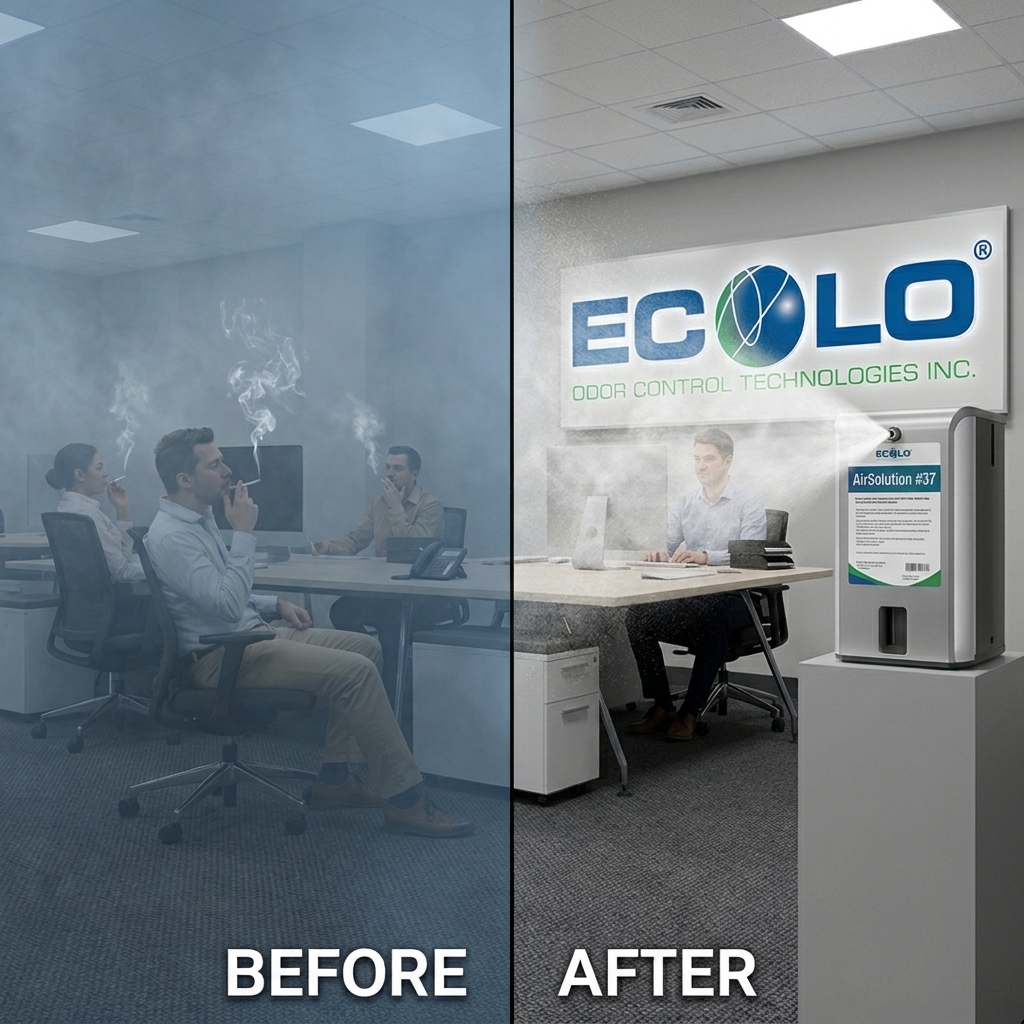
Smoke Odor Removal: How to Neutralize Tobacco, Cigarette, and Fire Smoke Odors
Smoke odor removal is one of the most challenging aspects of maintaining clean, comfortable indoor environments. Whether the source is cigarette smoke, tobacco use, cooking exhaust, or fire damage, smoke-related odors can remain noticeable long after the original source has disappeared.
For hotels, casinos, apartment buildings, restaurants, restoration contractors, and commercial property managers, persistent smoke odors can become a recurring operational problem.
A room may look perfectly clean while still carrying a strong cigarette smell. A renovated apartment may retain tobacco odors from previous occupants. A fire-damaged property may continue smelling smoky even after visible soot has been removed.
The challenge is that smoke odors are not always eliminated through conventional cleaning or air fresheners alone.
At Ecolo Odor Control Technologies, we approach smoke odor management through specialized odor-counteractant technology designed to address unwanted smells rather than simply covering them with stronger fragrances.
One product developed specifically for these applications is AirSolution #37 Smoke Away, a concentrated liquid odor counteractant formulated for tobacco, smoke, and related commercial odors.
This article explains why smoke odors persist, which environments are most affected, how professional odor counteractants work, and where AirSolution #37 can be incorporated into a comprehensive smoke odor management program.
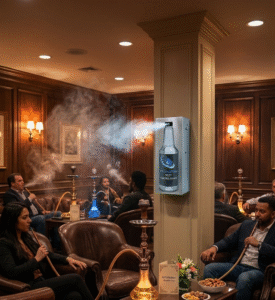
1. Why Are Smoke Odors So Difficult to Remove?
Smoke is not a single chemical compound.
It is a complex mixture of airborne particles, gases, and volatile or semi-volatile chemicals generated during combustion.
The exact composition depends on what is burning.
Cigarette smoke, cooking smoke, and smoke from a structural fire can contain different combinations of compounds.
Some remain airborne temporarily, while others deposit on surrounding surfaces.
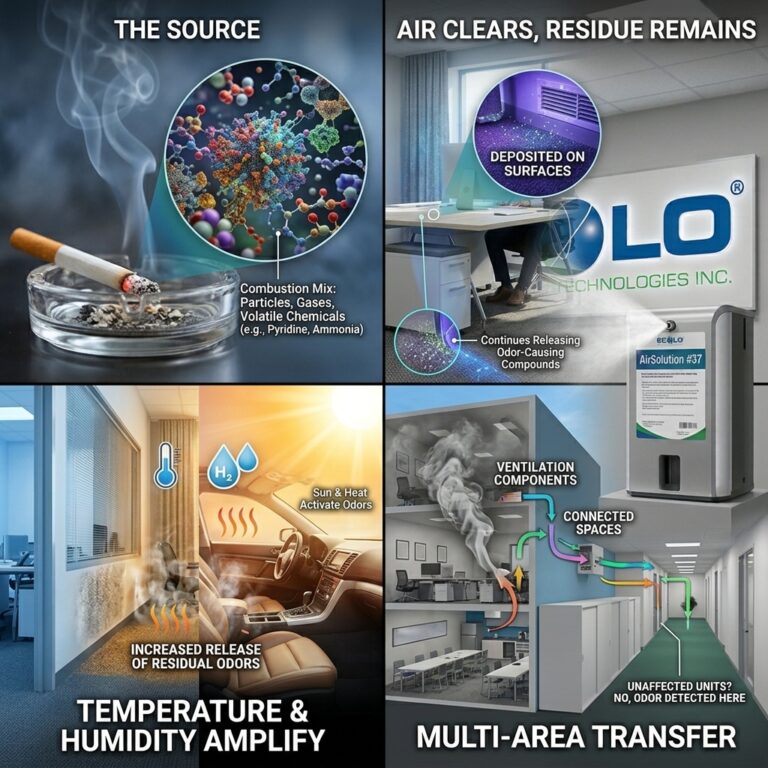
Smoke Residue Can Remain After the Air Clears
When tobacco smoke enters an indoor environment, some of its chemical constituents can accumulate on:
Walls and ceilings
Carpets and upholstery
Curtains and fabric
Furniture
Ventilation components
Vehicle interiors
Other exposed surfaces
These deposits may continue releasing odor-causing compounds over time.
This helps explain why opening windows or using conventional air fresheners may provide only temporary improvement.
Temperature and Ventilation Affect Smoke Odors
Smoke odor intensity may change depending on indoor conditions.
Higher temperatures, humidity, air circulation, and building ventilation can influence the movement and release of odor-causing compounds.
A hotel room may appear odor-free immediately after cleaning but develop a noticeable smell later.
Likewise, a vehicle may smell clean in a detailing shop but reveal residual smoke odors after sitting in the sun.
Smoke Odors Can Affect Multiple Areas
In commercial buildings, smoke-related odors may move through connected spaces and ventilation pathways.
For example, smoke originating in one apartment may affect neighboring corridors or units.
This makes it important to identify both the original source and the areas where odor is being detected.
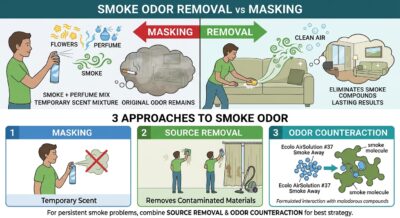
2. Smoke Odor Removal vs. Masking: What's the Difference?
One of the most common mistakes in smoke odor treatment is relying exclusively on fragrance.
A conventional air freshener may introduce a pleasant scent, but it does not necessarily eliminate the compounds responsible for the original odor.
Imagine entering a hotel room that smells strongly of cigarette smoke.
Spraying a floral fragrance may temporarily change how the room smells, but the result can become a mixture of tobacco and perfume.
The original odor problem may remain.
Professional smoke odor management should distinguish between three approaches.
Masking
Masking introduces another fragrance to compete with the unpleasant odor.
It may improve perceived scent temporarily without addressing the underlying contamination.
Source Removal
Source removal focuses on eliminating contaminated materials and residues.
This can involve cleaning surfaces, laundering fabrics, replacing heavily contaminated materials, and addressing ventilation systems.
Odor Counteraction
Odor counteraction uses specially formulated products intended to interact with malodorous compounds and reduce their perceived intensity.
Ecolo AirSolution #37 Smoke Away is designed for this third approach.
For persistent smoke problems, the most effective overall strategy may involve both source removal and odor counteraction.
3. Introducing AirSolution #37 Smoke Away
AirSolution #37 is a concentrated liquid odor counteractant developed by Ecolo for commercial applications involving tobacco smoke and other unpleasant odors.
According to its technical datasheet, the formulation is designed to target, neutralize, and remove tobacco and smoke odors through odor counteraction.
Unlike a conventional fragrance-based approach, AirSolution #37 is intended to interact with malodorous molecules.
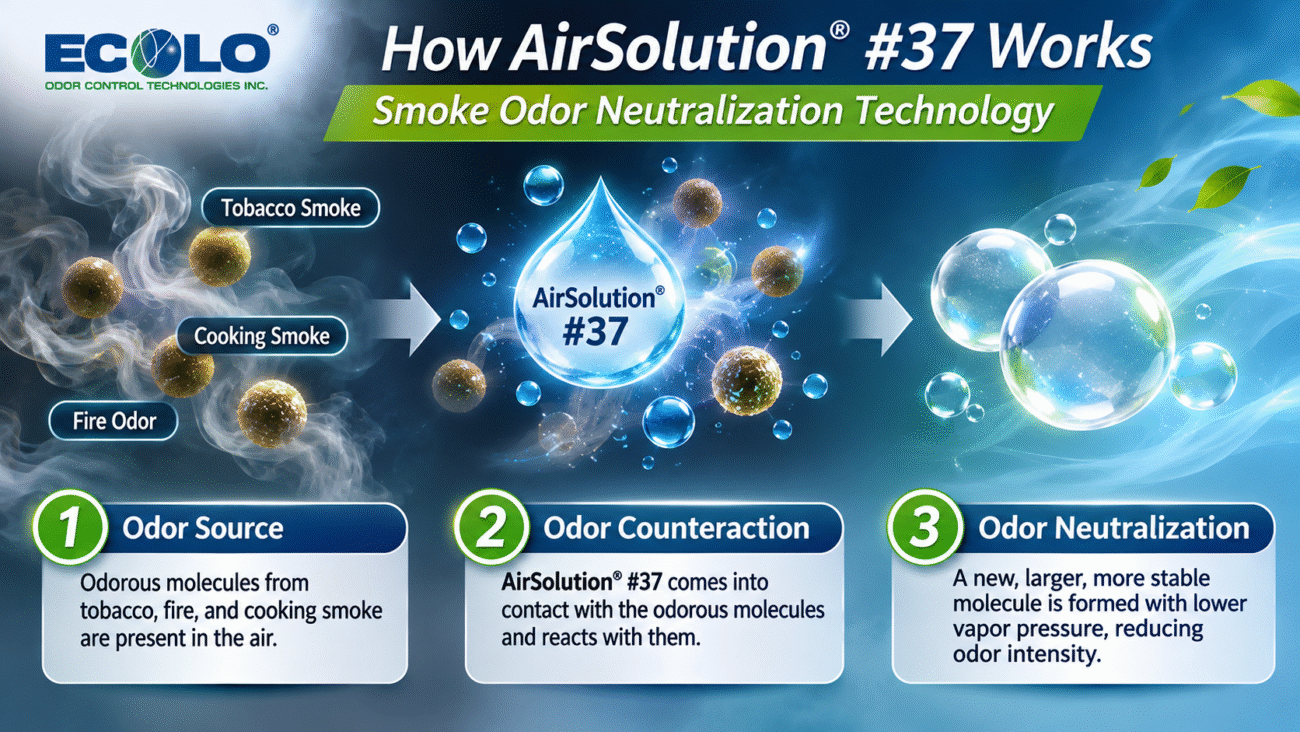
How AirSolution #37 Works
The product's technical datasheet describes a mechanism based on odor neutralization.
When properly diluted and misted into odorous air, the formulation is designed to react with malodorous molecules.
The described process forms larger molecules with lower vapor pressure, reducing the concentration of odor-causing compounds available in the air and thereby reducing perceived odor intensity.
The important distinction is that AirSolution #37 is designed for odor counteraction rather than fragrance masking alone.
Actual results depend on the odor source, application method, treatment concentration, environmental conditions, and extent of contamination.
AirSolution #37 is not intended to replace necessary cleaning or remediation procedures.
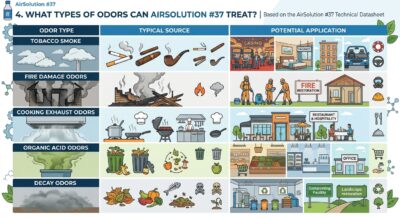
4. What Types of Odors Can AirSolution #37 Treat?
The AirSolution #37 technical datasheet identifies five odor categories.
| Odor Type | Typical Source | Potential Application |
|---|---|---|
| Tobacco smoke | Cigarettes, cigars, smoking areas | Casinos, hotel rooms, apartments, vehicles |
| Fire damage odors | Residual odors following fire incidents | Fire restoration projects |
| Cooking exhaust odors | Commercial kitchens and cooking operations | Restaurants and hospitality facilities |
| Organic acid odors | Certain organic decomposition processes | Commercial and service environments |
| Decay odors | Decomposing organic materials | Selected commercial applications |
Although AirSolution #37 is particularly suited to tobacco and smoke odors, the datasheet identifies additional odor categories that may be relevant to commercial operators.
Product suitability should always be evaluated for the specific application.
5. Smoke Odor Control for Casinos and Gaming Facilities
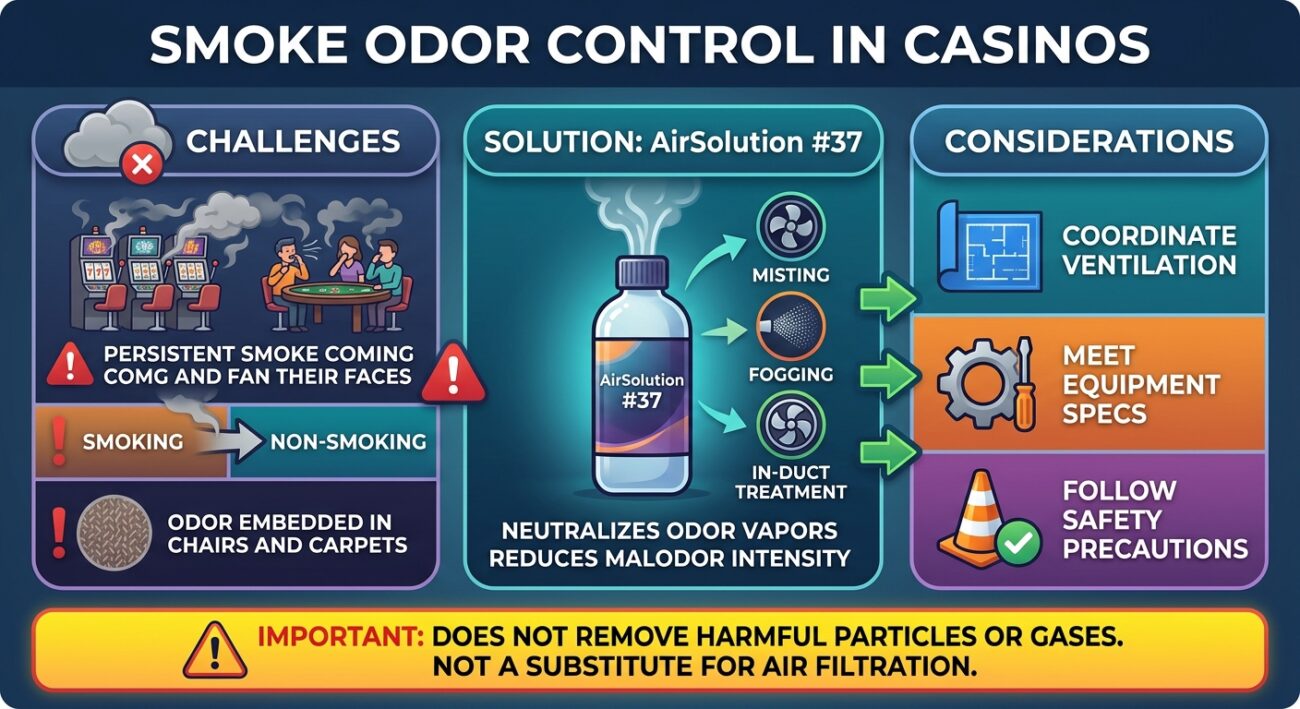
Casinos are among the commercial environments where tobacco smoke odor can present a persistent challenge.
In facilities that permit smoking, odor generation may be continuous during operating hours.
Large gaming floors can also have complex ventilation requirements and significant occupant activity.
Common Challenges
Casino operators may experience:
Persistent tobacco smoke odors
Odor migration into neighboring areas
Odor accumulation in furnishings and carpets
Different smoking and nonsmoking zones
High visitor expectations for indoor comfort
How AirSolution #37 Can Help
The AirSolution #37 datasheet specifically identifies casinos as an applicable environment.
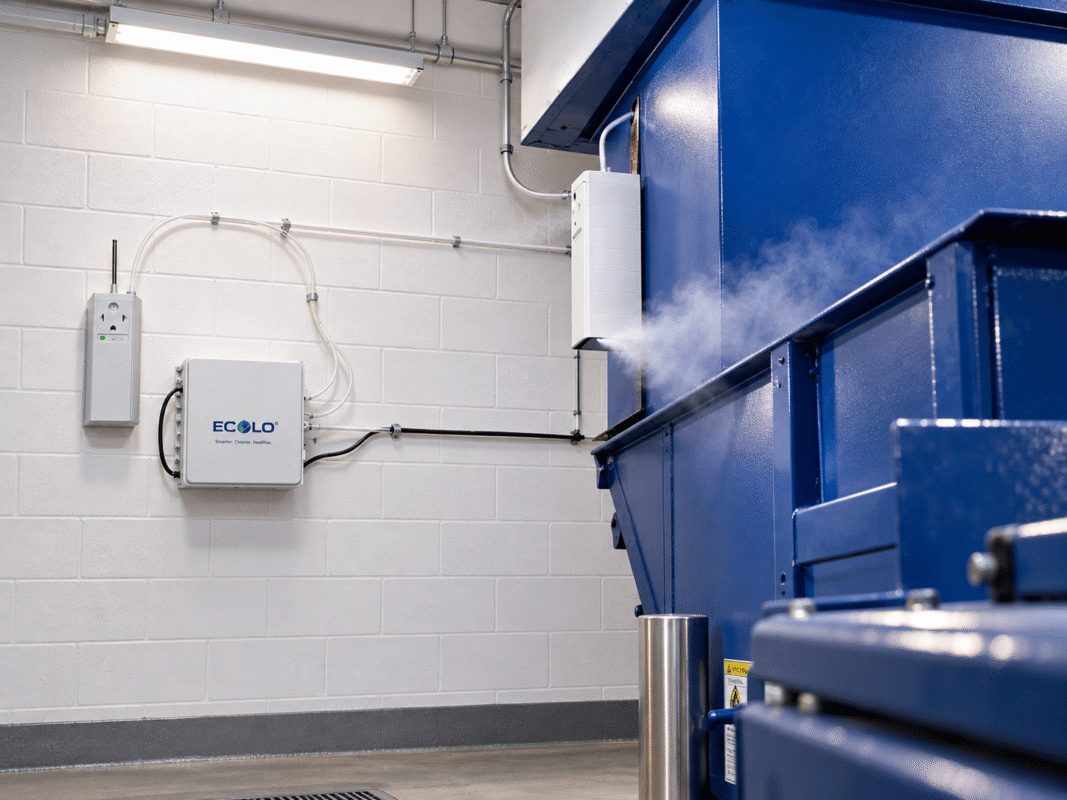
Depending on the building configuration, the product may be evaluated for misting, fogging, or in-duct treatment.
The objective is to reduce the intensity of smoke-related malodors within the treated environment.
Any application must be coordinated with the facility's ventilation strategy, equipment requirements, and applicable safety precautions.
Odor counteraction should not be confused with the removal of harmful smoke particles or gases.
6. Tobacco Smoke Odor Removal for Hotels and Hospitality Properties
For hotel operators, the smell of cigarette smoke can affect guest satisfaction and room readiness.
This is particularly challenging when smoke odors remain after a room has been cleaned.
Where Smoke Odors Accumulate
Common locations include:
Guest rooms
Corridors
Upholstered furniture
Curtains
Carpets
HVAC components
Public spaces
Areas adjacent to smoking zones
A Professional Treatment Strategy
A comprehensive approach may involve:
Identifying the original smoke source.
Cleaning contaminated surfaces and fabrics.
Evaluating ventilation and filtration.
Applying an appropriate smoke odor counteractant.
Reassessing odor conditions after treatment.
AirSolution #37 can be considered as part of the odor-counteraction stage.
The technical datasheet identifies hotel lobbies among its applicable areas, and other hospitality applications should be evaluated individually.
For hotels, this type of treatment may help support more consistent odor-management practices.
7. Smoke Odor Removal in Apartments and Condominiums
Apartment buildings and condominium communities can experience persistent tobacco odors from previous occupants, smoking activity, or smoke migration between units.
For property managers, these problems may become particularly noticeable during unit turnover.
Common Apartment Smoke Odor Problems
Smoke-related odors can affect:
Vacant rental units
Previously occupied condominiums
Common corridors
Residential lobbies
Shared amenity areas
Adjacent units
Building ventilation pathways
Why Cleaning Alone May Not Be Enough
In properties exposed to repeated indoor smoking, odor-causing compounds can accumulate on surfaces and furnishings.
Standard cleaning may remove visible dirt without fully addressing smoke residue.
A more thorough process may involve surface cleaning, laundering or replacing contaminated materials, ventilation evaluation, and targeted odor treatment.
AirSolution #37 for Residential Property Management
The technical datasheet identifies apartments and condominiums as suitable application environments.
Ecolo can work with property managers to evaluate whether misting, fogging, or another technically appropriate application method is suitable.
Treatment should be planned around the building's layout, occupancy, ventilation, and safety requirements.
8. Fire Restoration: Addressing Residual Smoke Odors After a Fire
Smoke odor following a fire can be especially difficult to manage because the odor source may extend beyond the visible damage.
Fire smoke can affect walls, ceilings, furniture, insulation, ventilation components, and concealed spaces.
The specific contamination depends on the materials burned and the extent of exposure.
Why Fire Odors Persist
Fire-related smoke residues can remain on surfaces and within porous materials.
Even after the visible debris has been removed, residual odors may continue to be released.
The Role of Odor Counteractants
AirSolution #37 identifies fire damage odors and fire restoration among its target odors and applications.
For restoration professionals, an odor counteractant can be considered as one component of a broader remediation process.
However, it does not replace:
Removal of fire-damaged materials
Soot and residue cleaning
Appropriate HVAC cleaning
Moisture management
Contaminant assessment
Ventilation and filtration
A successful restoration project must address both contamination and residual odor.
Reducing smoke smell does not establish that a fire-damaged environment is safe for occupancy.
9. Smoke Odor Removal for Car Detailing and Vehicle Interiors
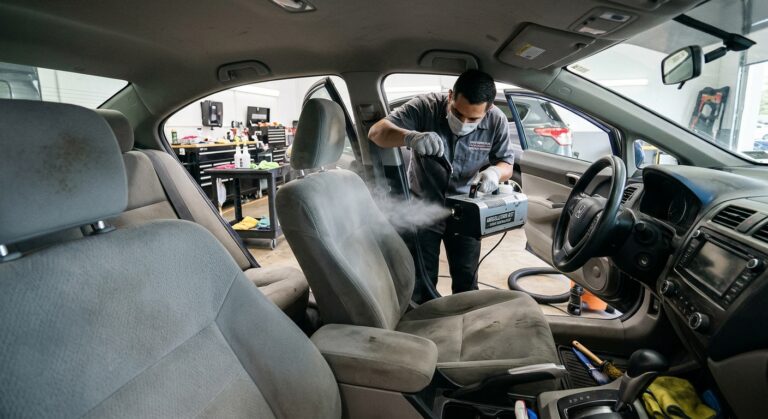
Tobacco smoke can leave persistent odors inside vehicles.
Vehicle interiors contain numerous materials that can retain smoke-related compounds, including fabric seats, carpeting, headliners, and ventilation components.
This can be particularly problematic for:
Used-car dealerships
Automotive detailing companies
Vehicle rental businesses
Fleet operators
Automotive reconditioning services
Why Vehicle Smoke Odors Return
Smoke residues can remain on interior surfaces.
Heat and air circulation may contribute to renewed odor release after a vehicle has been cleaned.
Professional Odor Treatment
The AirSolution #37 datasheet identifies car detailing as an applicable market.
A professional process should begin with cleaning contaminated surfaces and interior materials.
An appropriate odor-counteractant treatment may then be evaluated to address remaining smoke-related odors.
Application should account for interior materials, ventilation, and compatibility with the selected treatment method.
10. Restaurants, Nightclubs, Bars, and Banquet Halls
Smoke-related odor challenges are not limited to tobacco.
Commercial kitchens and hospitality venues may also experience odors from cooking exhaust, smoke, and organic residues.
AirSolution #37 identifies several relevant environments:
Restaurants
Nightclubs and bars
Banquet halls
Casinos
Hotel lobbies
These environments can differ significantly in their ventilation, occupancy, and odor characteristics.
For example, cooking exhaust odors may require a different application strategy from residual cigarette smoke in a hospitality venue.
The product datasheet identifies cooking exhaust among the odor categories treated, but site-specific evaluation remains important.
11. How Is AirSolution #37 Applied?
AirSolution #37 is a concentrated formulation intended to be diluted before application.
The technical datasheet provides guidance for misting, fogging, and in-duct treatment.
Misting and Fogging
The recommended dilution range is:
1:3.4 to 1:4
The product should be mixed with clean potable water before use.
Misting or fogging equipment then distributes the diluted formulation into the treatment area.
The objective is to provide contact between the treatment droplets and malodorous air.
Actual application rates should be determined according to the odor intensity, room characteristics, ventilation, and equipment configuration.
In-Duct Treatment
For in-duct treatment, the technical datasheet provides the following concentrate usage guidance:
6–12 mL of concentrate per 1,000 m³/hour of airflow
The datasheet also provides an approximate imperial reference of:
1–2 fluid ounces of concentrate per 3,000 CFM of airflow
These figures are application guidelines rather than guarantees of performance.
Airflow, particulate concentration, temperature, and odor intensity can influence the amount of treatment required.
In-duct application should be reviewed for compatibility with the ventilation system, safety requirements, and equipment design.
Product Preparation and Storage
The datasheet specifies that:
The product should be mixed with clean potable water.
Mixed product should be used within 30 days for optimal performance.
Concentrated product should be used within one year.
Optimal storage temperature is 8°C to 25°C.
Product should be stored in an unopened container in a dry location.
These handling requirements should be incorporated into any commercial treatment program.
12. Important Safety Considerations for Smoke Odor Treatment
Professional odor-control applications require appropriate safety planning.
The AirSolution #37 technical datasheet classifies the concentrate as:
Flammable Liquid — Class 3, Packing Group III.
This classification is important for transportation, storage, handling, and treatment planning.
Operators should review the current Safety Data Sheet before use and confirm the suitability of the equipment and application environment.
Special attention is necessary when working around ignition sources, electrical equipment, ventilation systems, or occupied spaces.
Because the concentrate is classified as flammable, fogging or misting should not be undertaken without confirming the relevant safety requirements.
Smoke odor neutralization also does not mean that harmful smoke constituents, combustion particles, carbon monoxide, or other hazardous contaminants have been removed.
AirSolution #37 should be considered an odor-management product, not an air-purification or life-safety system.
14. How to Choose the Right Smoke Odor Treatment Strategy
Before selecting a smoke odor counteractant, facility managers should evaluate several factors.
Identify the Smoke Source
Is the problem caused by tobacco, cooking exhaust, fire damage, or another source?
Determine Whether the Source Is Still Active
Continuous smoking in an occupied venue requires a different strategy from residual smoke odor in a vacant apartment.
Evaluate Surface Contamination
If smoke residues remain on walls, furniture, or ventilation components, cleaning and remediation may be necessary before odor treatment.
Review the Treatment Area
Important considerations include:
Room dimensions
Airflow and ventilation
Occupancy
Temperature
Odor intensity
Surface materials
Available equipment
Ignition hazards
Treatment frequency
Select the Application Method
Misting, fogging, or in-duct treatment may be considered depending on the environment and technical requirements.
Conduct a Controlled Trial
Ecolo's technical datasheet recommends testing the proposed application before repetitive use.
A trial can help determine whether the selected treatment method achieves the desired odor reduction under actual operating conditions.
15. Frequently Asked Questions About Smoke Odor Removal
Can cigarette smoke odor be removed from a room?
Smoke odors can often be reduced substantially through appropriate cleaning, ventilation, source removal, and targeted odor treatment.
The results depend on the extent of smoke contamination and the materials affected.
Does AirSolution #37 simply cover cigarette odors with fragrance?
No. According to its technical datasheet, AirSolution #37 is designed to counteract malodorous molecules rather than relying solely on masking.
Can AirSolution #37 be used in hotels?
The datasheet identifies hotel lobbies as an applicable environment. Other hotel applications should be evaluated for technical suitability and safety.
Is AirSolution #37 suitable for fire restoration?
The datasheet identifies fire damage odors and fire restoration among its applications. The product may be used as part of a comprehensive restoration strategy, but it does not replace contamination removal.
Can AirSolution #37 be used in HVAC systems?
The datasheet provides in-duct treatment guidance. Any installation should be reviewed for equipment compatibility, airflow, safety, and application requirements.
Is AirSolution #37 a ready-to-use product?
No. It is a concentrate that must be diluted with clean potable water according to the product's technical guidance.
Does removing smoke odor make indoor air safe?
Not necessarily. Odor reduction does not establish that smoke particles, harmful gases, or hazardous residues have been removed.
16. Partner With Ecolo for Professional Smoke Odor Control
Persistent smoke odors can create significant challenges for commercial property managers, restoration contractors, hospitality operators, and automotive service providers.
The appropriate solution depends on the source of the smoke, the affected environment, and the extent of contamination.
At Ecolo Odor Control Technologies, we provide specialized odor-counteractant formulations designed for demanding commercial applications.
AirSolution #37 Smoke Away is formulated to address tobacco smoke and related malodors through odor counteraction.
Potential applications include:
Casinos
Nightclubs and bars
Restaurants
Apartments and condominiums
Car detailing
Banquet halls
Hotel lobbies
Fire restoration
Whether your organization is dealing with cigarette smoke in a commercial property, residual odors following a fire, or persistent tobacco odors in a vehicle or apartment, Ecolo can help evaluate the application and recommend an appropriate treatment approach.
Let's Make Smoke Odor One Less Problem for Your Business
If you are a property manager, hotel operator, restoration professional, cleaning contractor, or commercial facility manager experiencing persistent smoke odors, contact Ecolo to discuss your application.
Our team can help review the odor source, treatment environment, operating conditions, and equipment requirements to determine whether AirSolution #37 Smoke Away is suitable.
We also welcome collaboration with restoration companies, cleaning businesses, automotive detailing providers, and facility management organizations interested in offering specialized smoke odor-control services to their customers.
Ecolo Odor Control Technologies Inc.
Toronto, Canada | Houston, Texas
Website: www.ecolo.com | www.ecolofresh.com
Email: info@ecolo.com
Don't just cover up smoke odors. Address them with professional odor-counteractant technology.