WEFTEC 2026: Advancing Wastewater Odor Control with Smarter Treatment Technologies

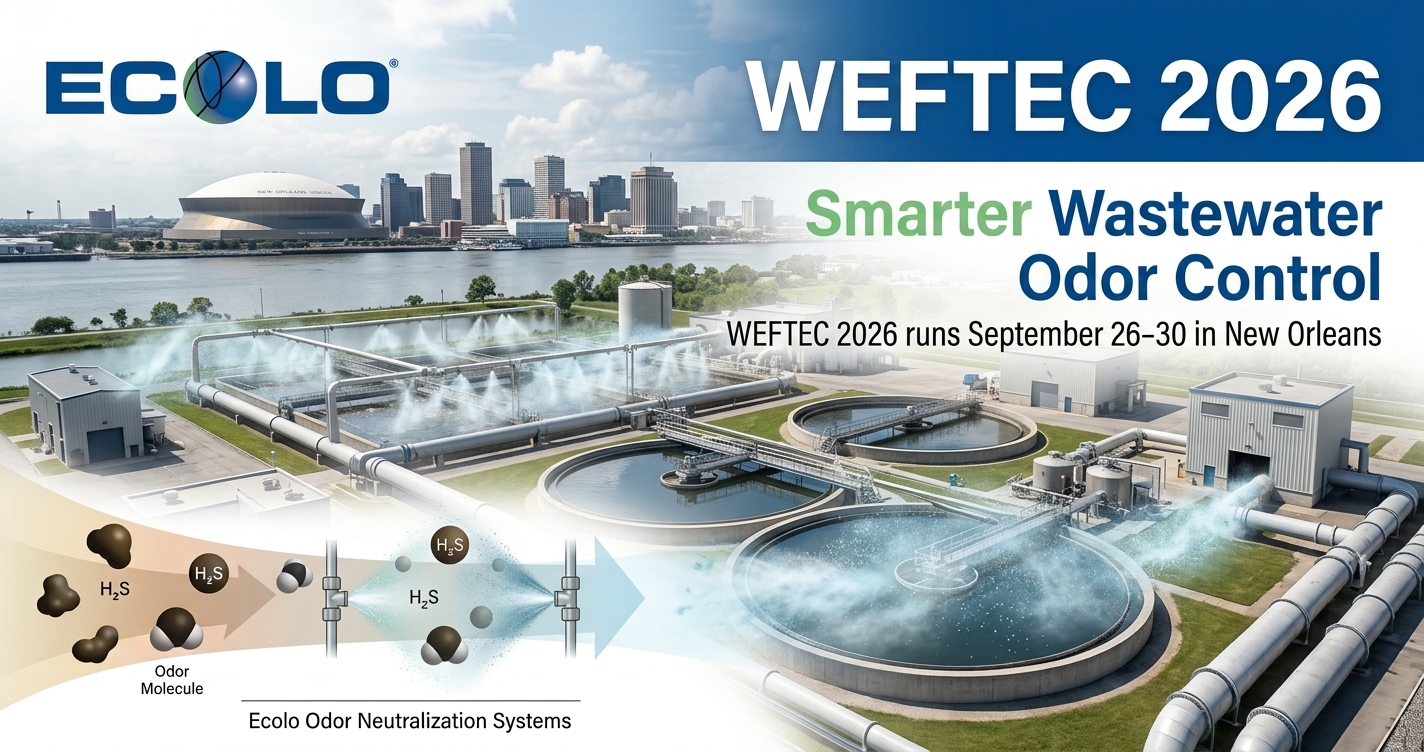
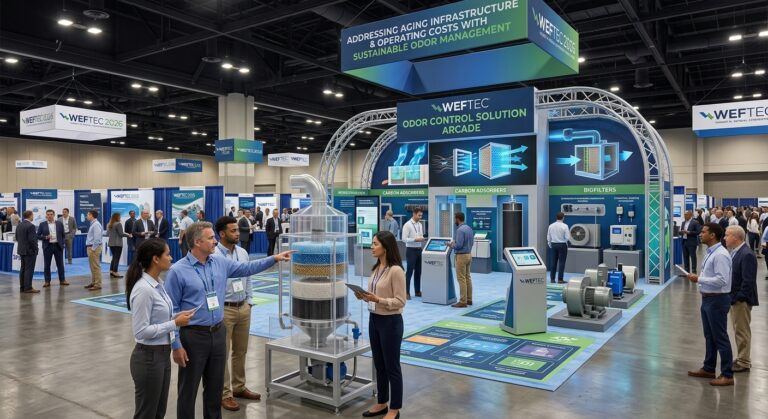
The global water industry is preparing to gather in New Orleans for WEFTEC 2026, and one operational challenge remains particularly important for wastewater utilities, engineers and treatment professionals: odor control.
From hydrogen sulfide (H₂S) at headworks and pumping stations to organic decomposition odors from sludge, lagoons and wastewater storage, odor is more than a nuisance.
Persistent wastewater odors can affect workers, neighboring communities, equipment, infrastructure and public perception of treatment facilities.
At Ecolo Odor Control Technologies, wastewater odor management has been an important part of our work for decades.
As the water community comes together at WEFTEC 2026, we believe it is an ideal time to discuss how wastewater facilities can move beyond simply reacting to odor complaints and instead develop a comprehensive strategy that addresses where odors originate, how they are generated and how they migrate beyond the treatment process.
What Is WEFTEC 2026?
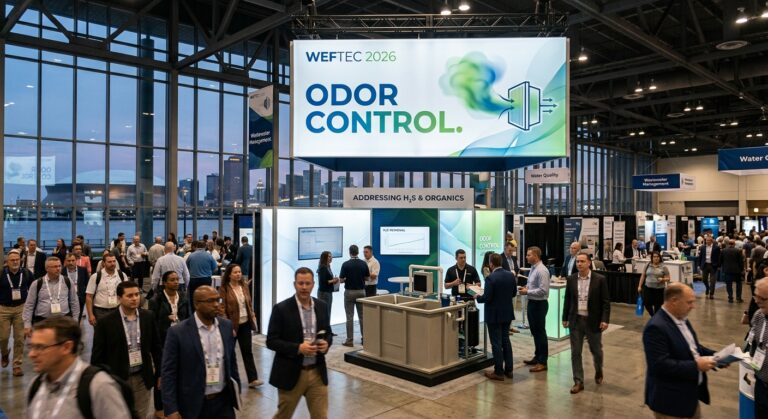
WEFTEC—the Water Environment Federation's Technical Exhibition and Conference—is one of the world's major events dedicated to water and wastewater.
WEFTEC 2026 will take place September 26–30, 2026, at the Ernest N. Morial Convention Center in New Orleans, Louisiana.
The exhibition runs from September 28–30.
More than 23,000 water professionals from around the world are expected to participate, alongside approximately 1,000 exhibiting companies showcasing technologies and services for the water sector.
The event combines technical education, workshops, demonstrations, facility tours, networking and an extensive exhibition floor.
For wastewater professionals, it creates an opportunity to examine a fundamental question:
How can treatment facilities improve performance while managing aging infrastructure, operating costs, environmental requirements and community expectations?
Odor control belongs in that conversation.
Why Wastewater Odor Control Still Matters
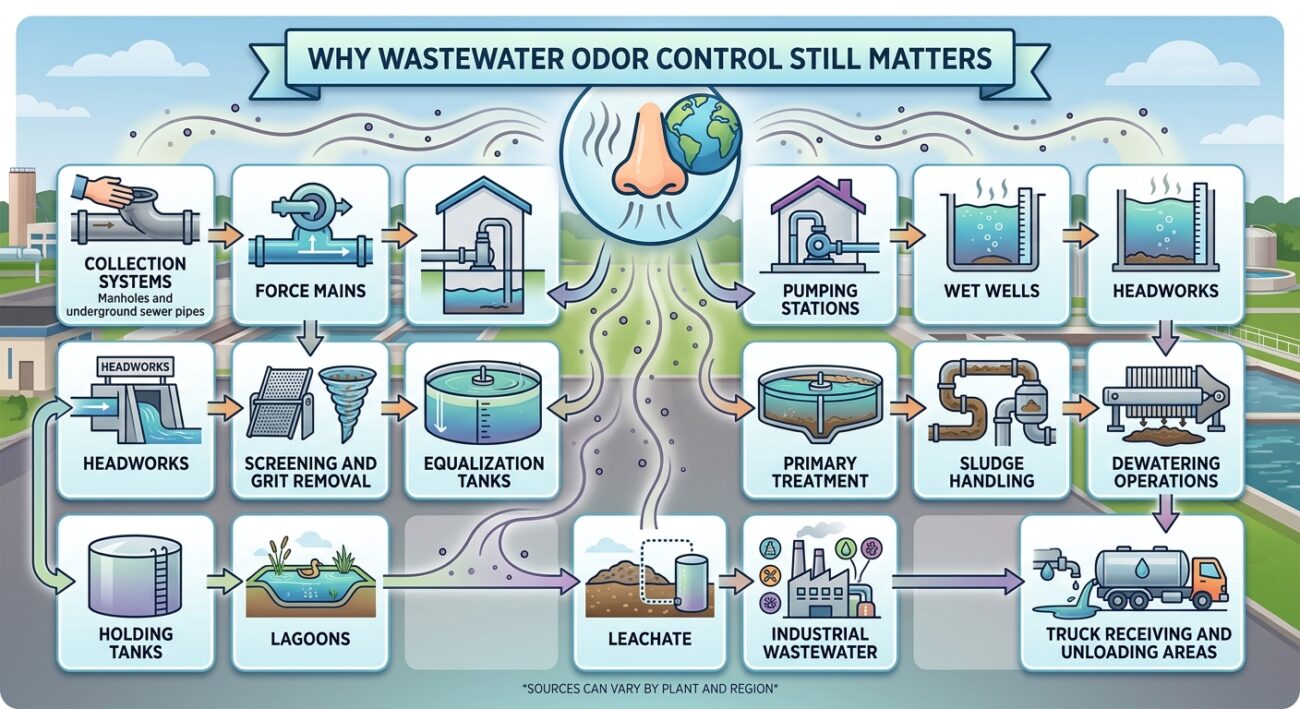
Anyone who operates a wastewater facility knows that odor problems rarely originate from a single location.
Potential sources can include:
- Collection systems
- Force mains
- Pumping stations
- Wet wells
- Headworks
- Screening and grit removal
- Equalization tanks
- Primary treatment
- Sludge handling
- Dewatering operations
- Holding tanks
- Lagoons
- Leachate
- Industrial wastewater
- Truck receiving and unloading areas
The chemistry is equally complex.
Wastewater odors can contain hydrogen sulfide, mercaptans, amines, ammonia, volatile fatty acids and numerous organic decomposition compounds.
Each compound behaves differently.
And that means there is rarely a universal odor-control technology appropriate for every application.
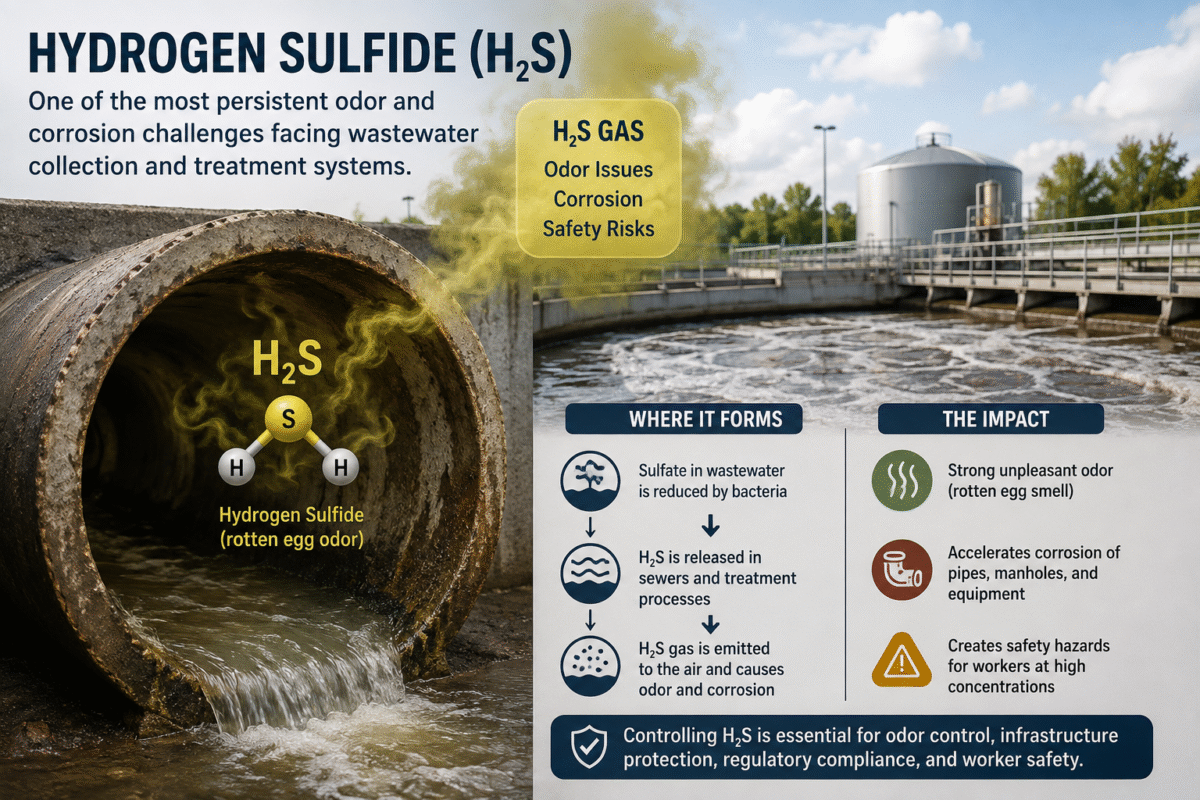
Hydrogen Sulfide: One of Wastewater's Most Recognizable Problems
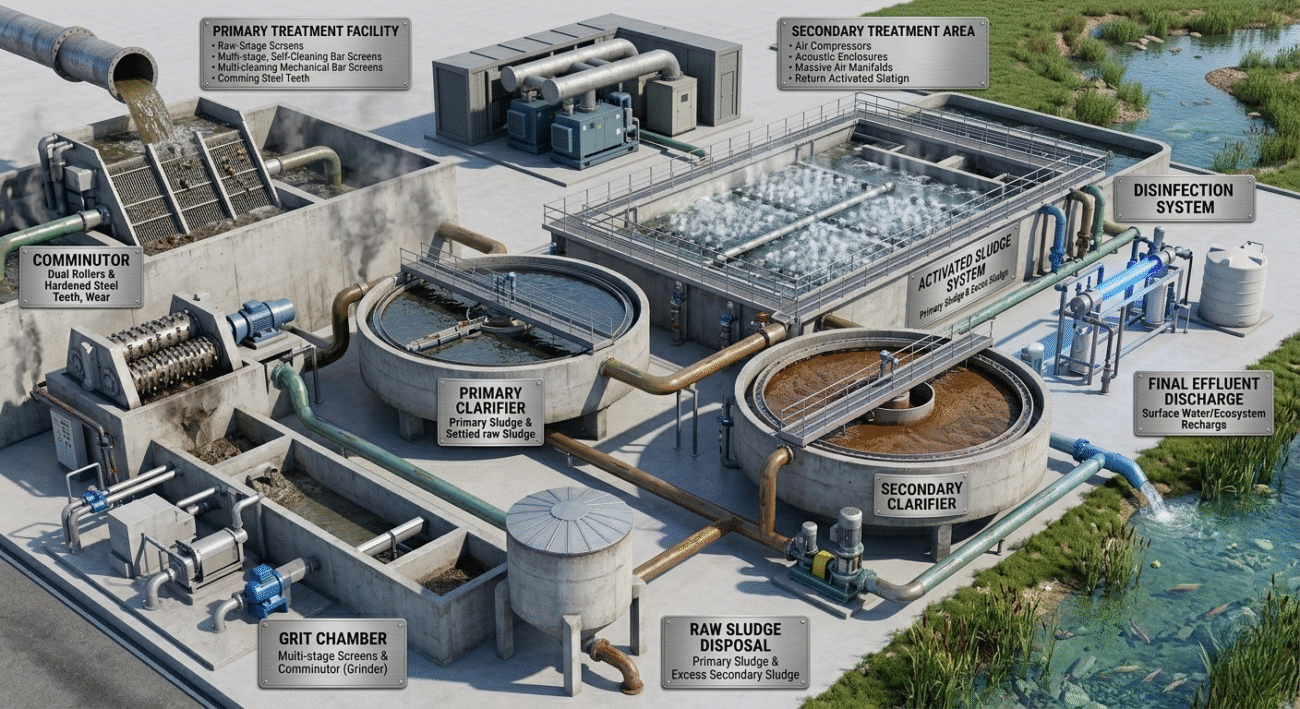
Hydrogen sulfide deserves particular attention.
H₂S is associated with the characteristic rotten-egg odor frequently encountered around wastewater systems.
It commonly develops when wastewater experiences oxygen-deficient conditions and sulfate-reducing microorganisms convert sulfate into sulfide.
Once H₂S transfers from wastewater into the air, facilities can face several problems.
Beyond odor complaints, elevated H₂S concentrations create occupational safety concerns.
There is also an infrastructure issue.
In wastewater environments, H₂S can participate in biological processes that ultimately form sulfuric acid on exposed surfaces, contributing to corrosion of concrete and other infrastructure.
For municipalities investing millions of dollars in wastewater infrastructure, controlling sulfide is therefore not simply about making a facility smell better.
It can be part of a broader operational strategy.
The First Question Should Be: Where Is the Odor Coming From?
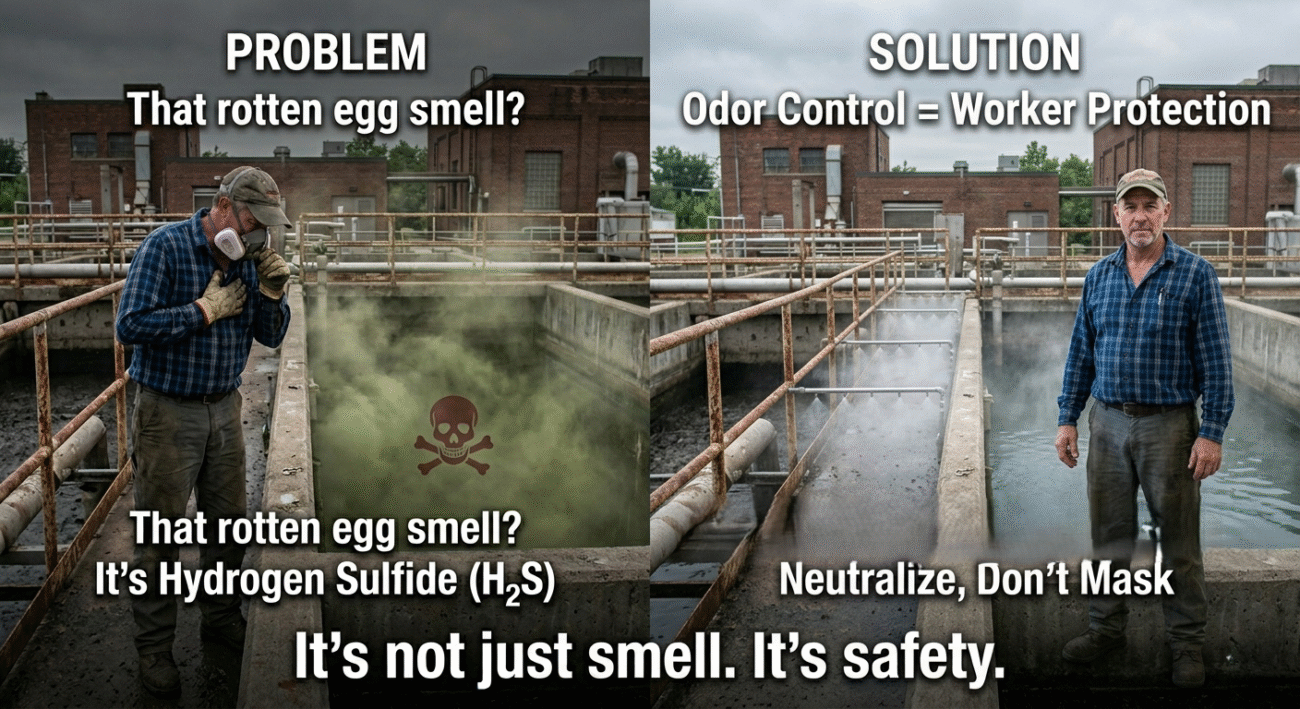
Before selecting an odor-control system, Ecolo recommends identifying the source.
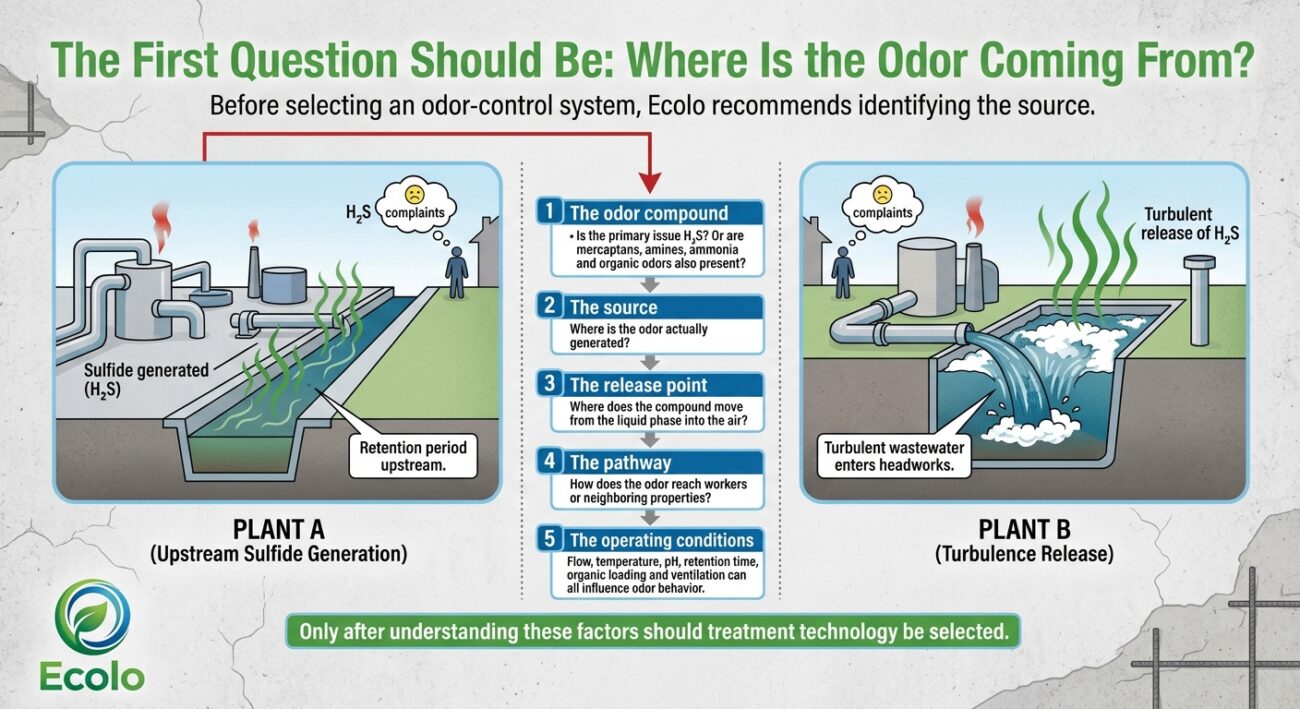
Consider two wastewater plants experiencing H₂S complaints.
At the first plant, sulfide is being generated during a long wastewater retention period upstream.
At the second, wastewater chemistry may be relatively manageable, but significant H₂S is released when turbulent wastewater enters the headworks.
The odor compound may be the same.
The appropriate treatment strategy may be completely different.
That is why odor-control design should begin by examining:
1. The odor compound
Is the primary issue H₂S?
Or are mercaptans, amines, ammonia and organic odors also present?
2. The source
Where is the odor actually generated?
3. The release point
Where does the compound move from the liquid phase into the air?
4. The pathway
How does the odor reach workers or neighboring properties?
5. The operating conditions
Flow, temperature, pH, retention time, organic loading and ventilation can all influence odor behavior.
Only after understanding these factors should treatment technology be selected.
Three Levels of Wastewater Odor Control
One useful way to approach wastewater odor management is to divide treatment into three levels.
Level 1: Control Odor Formation in the Wastewater
The first opportunity is often before the odor becomes airborne.
If biological decomposition is contributing to odor generation, modifying conditions within the wastewater can reduce the production of undesirable compounds.
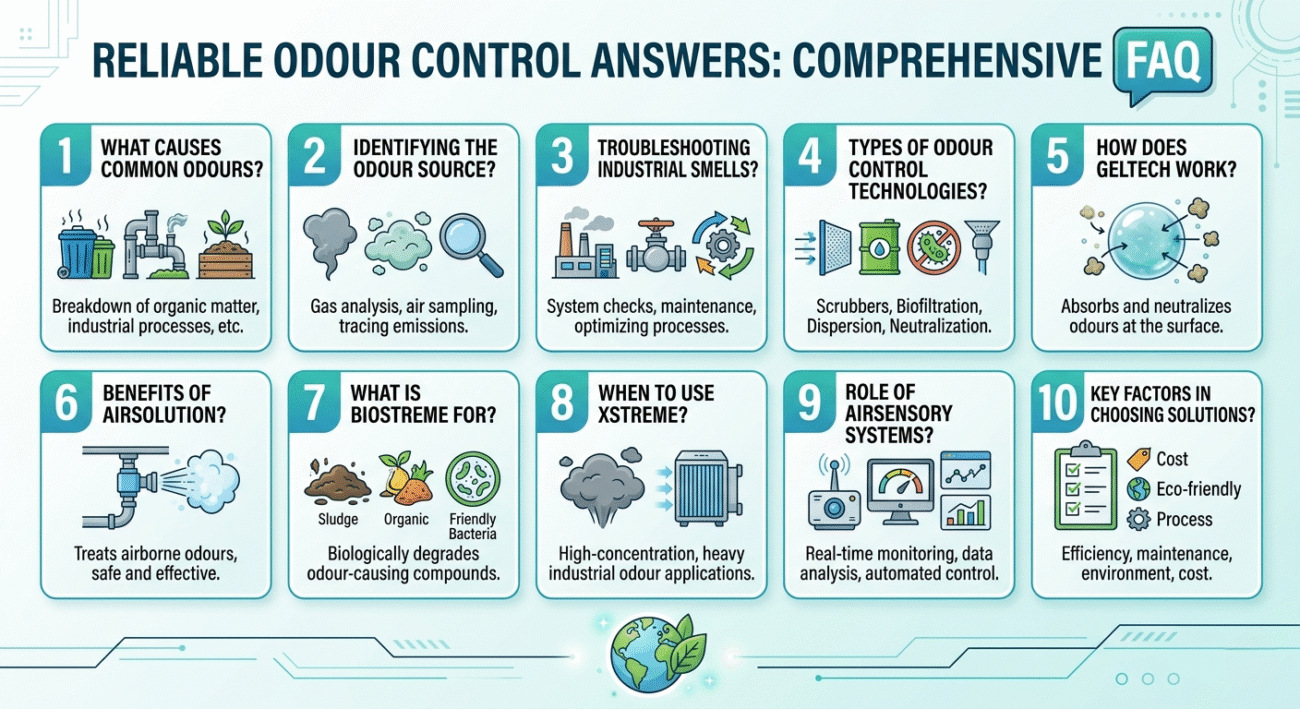
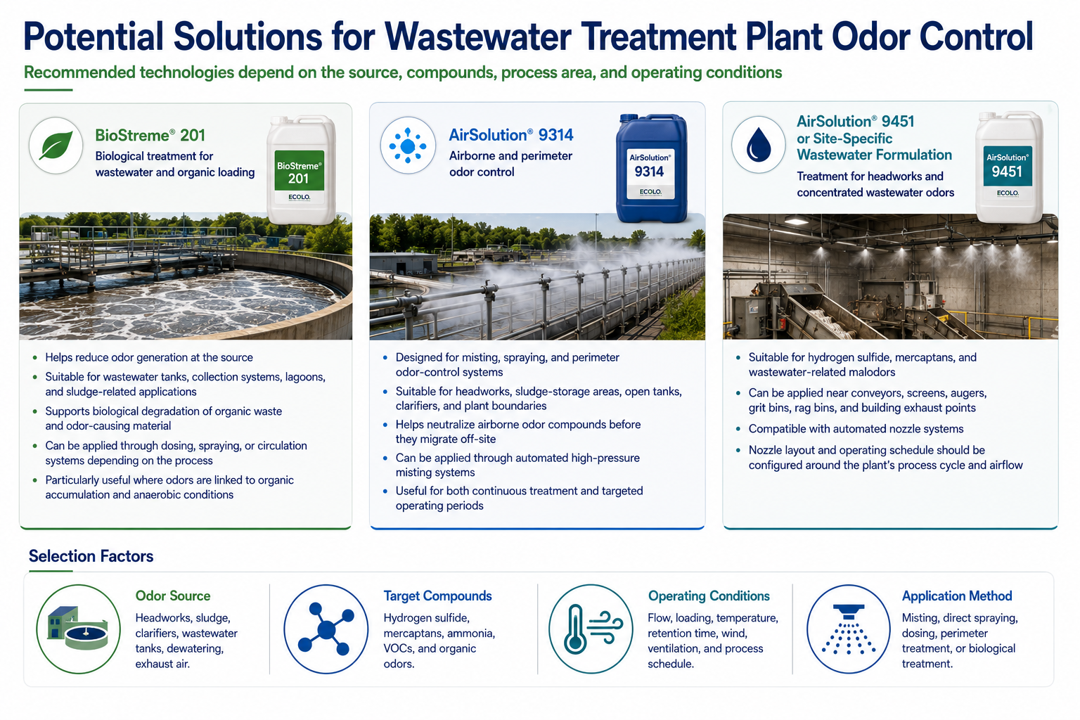
This is where biological technologies such as BioStreme 201 can become relevant.
BioStreme 201 is a concentrated micronutrient formulation designed to support populations of naturally occurring facultative bacteria.
Rather than introducing bacteria into the wastewater, the technology provides nutrients intended to support beneficial microorganisms already present within the biological environment.
The objective is to encourage effective decomposition of biological waste without producing the same level of odorous by-products associated with undesirable anaerobic processes.
This approach can be particularly relevant to wastewater with substantial organic loading.
Level 2: Treat Odor at the Release Point
Not every odor can be prevented in the liquid phase.
At locations such as:
- Headworks
- Wet wells
- Sludge areas
- Receiving stations
- Open tanks
- Dewatering equipment
odorous gases may already be entering the atmosphere.
At that point, treatment needs to address the airborne odor.
Ecolo's AirSolution technology is designed for this type of application.
Depending on the site, an odor counteractant can be distributed through engineered atomization or misting systems around the source.
The objective is to create sufficient contact between the treatment droplets and malodorous compounds.
This can be particularly useful where traditional containment or large air-handling systems are difficult to install.
Level 3: Prevent Odor Migration Beyond the Facility
A wastewater facility may control its strongest point sources and still experience occasional off-site complaints.
Wind direction, temperature, humidity, process changes and seasonal conditions can affect odor migration.
For open treatment areas, lagoons, sludge operations and other large sources, a perimeter odor-control strategy may therefore provide another layer of protection.
Engineered misting systems can establish treatment zones around critical boundaries or odor-generating areas.
Rather than treating the entire atmosphere indiscriminately, the system can be designed around the actual source and prevailing site conditions.
BioStreme 201: Addressing the Biological Side of Wastewater Odor
One technology we believe wastewater professionals should understand is BioStreme 201 BioBooster.
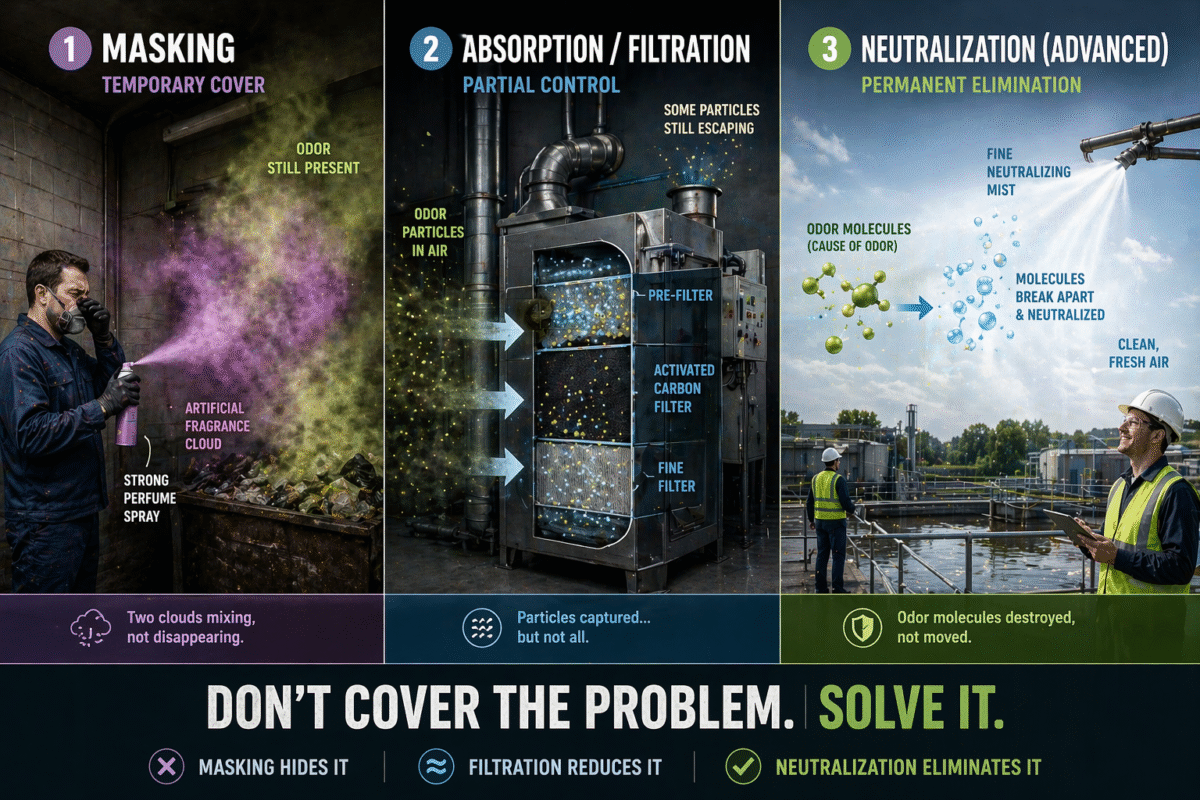
BioStreme approaches odor differently from a conventional masking chemical.
It is designed to support naturally occurring facultative bacteria that help break down biological waste.
Potential applications include:
- Municipal wastewater
- Industrial wastewater
- Bioreactors
- Holding tanks
- Leachate
- Food-processing wastewater
- Rendering wastewater
- Pulp and paper applications
BioStreme 201 is also designed to assist with broader wastewater parameters, including BOD, COD, suspended solids and sludge, depending on the application and wastewater characteristics.
This distinction matters.
If H₂S is only one symptom of high organic loading and poor biological conditions, concentrating exclusively on airborne H₂S may leave the underlying process unchanged.
Biological conditioning provides another tool for addressing the problem closer to its origin.
AirSolution: When the Odor Is Already in the Air
The second side of the strategy is airborne odor treatment.
Once H₂S, mercaptans and organic compounds leave the wastewater, biological conditioning alone may not address what workers and neighboring communities are experiencing.
An appropriately selected AirSolution odor counteractant can be applied through:
- High-pressure misting
- Fogging
- Perimeter systems
- Localized source treatment
- Duct applications
For wastewater applications, the exact formulation should be selected according to the odor profile.
The objective is not simply to introduce a stronger fragrance.
Effective counteractant treatment requires contact with the malodorous compounds so their behavior in the atmosphere can be changed and perceived odor intensity reduced.
Automation Is Becoming Increasingly Important
Another theme highly relevant to WEFTEC is automation.
Wastewater treatment facilities cannot rely indefinitely on an operator manually spraying chemicals whenever somebody notices an odor.
A modern odor-control strategy can use automated equipment to manage:
- Treatment schedules
- Chemical consumption
- Multiple treatment zones
- Operating frequency
- Pumps
- Nozzle networks
- Treatment duration
Ecolo's AMC automated misting technology can be configured to distribute odor-control formulations through engineered nozzle networks.
This makes odor treatment repeatable.
For a plant manager, that means moving from:
Complaint → employee notices problem → manual response
toward:
Known source → engineered treatment → programmed operation → monitoring → optimization
That is a significant operational difference.
What Should Wastewater Professionals Ask Before Purchasing an Odor-Control System?
The WEFTEC exhibition floor offers access to an enormous range of environmental technologies.
That makes technical evaluation especially important.
Before selecting an odor-control solution, operators and engineers should ask:
- What odor compounds are we actually treating?
- What are the measured H₂S concentrations?
- Is the problem continuous or intermittent?
- Is odor generated in the liquid or introduced by a particular process?
- What is the airflow?
- What is the wastewater flow?
- What is the hydraulic retention time?
- Is the source enclosed or open?
- What treatment area needs coverage?
- How much chemical will the system consume?
- What maintenance is required?
- Can the treatment respond to changing odor loads?
- How will we measure success?
Perhaps most importantly:
Are we treating the cause, the airborne odor, or both?
A technically sound proposal should be able to answer that question.
Measuring Success: Don't Rely Only on Your Nose
Odor perception is important because community complaints are ultimately based on human experience.
But engineering decisions should use objective information whenever practical.
Depending on the project, wastewater facilities may monitor:
- H₂S concentration
- Dissolved sulfide
- BOD
- COD
- pH
- ORP
- Temperature
- Dissolved oxygen
- Ammonia
- Suspended solids
- Sludge accumulation
- Chemical consumption
- Odor complaints
Baseline measurements should ideally be collected before treatment begins.
After implementation, the same parameters can be monitored.
This allows operators to determine whether a technology is actually improving conditions rather than relying solely on anecdotal observations.

WEFTEC 2026 and the Future of Wastewater Treatment
WEFTEC is valuable because it brings different parts of the water industry together.
Municipal utilities can speak with technology manufacturers.
Engineers can compare treatment approaches.
Operators can explain what actually happens inside plants.
Researchers can present new findings.
Manufacturers can learn where existing technologies still fall short.
WEFTEC's 2026 program includes more than 125 technical sessions alongside the large exhibition, workshops and other learning opportunities.
That exchange of operational knowledge is particularly important for odor control.
There is no single machine, chemical or biological process that solves every wastewater odor problem.
The future is increasingly about integrated treatment.
For odor management, that can mean combining:
Biological treatment + airborne counteractants + engineered delivery systems + automation + monitoring.
New Orleans: A Global Meeting Point for the Water Industry
WEFTEC 2026 will bring water professionals from around the world to New Orleans from September 26–30, with the exhibition running September 28–30.
The event is expected to connect more than 23,000 water professionals representing utilities, engineering firms, technology providers and other organizations across the sector.
For Ecolo, conversations like these are particularly valuable.
Wastewater odor is highly site-specific.
A treatment strategy that works at one municipal plant may need substantial modification for an industrial wastewater facility, food processor, rendering operation or lagoon.
Sharing actual operating challenges is how better solutions are developed.
Let's Talk About Your Wastewater Odor Challenge
If your organization is attending WEFTEC 2026 in New Orleans, this is an excellent opportunity to evaluate how your facility currently approaches odor management.
Whether the challenge involves:
- Hydrogen sulfide
- Headworks odors
- Lift stations
- Sludge handling
- Organic wastewater
- Mercaptans
- Industrial wastewater
- Lagoons
- Off-site odor complaints
the first step should be understanding the source and treatment objective.
Ecolo Odor Control Technologies has more than 60 years of experience developing odor-control technologies for municipal, industrial and commercial applications.
Our approach includes BioStreme biological technologies, AirSolution odor counteractants and automated application systems designed to address different stages of the odor problem.
If you will be at WEFTEC 2026—or have a wastewater odor problem you would like us to review—contact Ecolo to discuss your application.
Good wastewater odor control should not start with asking which product to buy.
It should start with understanding why the odor is there in the first place.