Odor Control Toronto: Inside Ecolo’s Toronto Headquarters and Odor Control Technology

Odor Control Toronto: Inside Ecolo’s Toronto Headquarters and Odor Control Technology
Persistent odor is more than an inconvenience for wastewater plants, waste facilities, industrial operations and commercial buildings. It can create complaints from neighbouring communities, affect employee and visitor comfort, indicate process issues and, in some applications, accompany compounds that require additional health and safety controls.
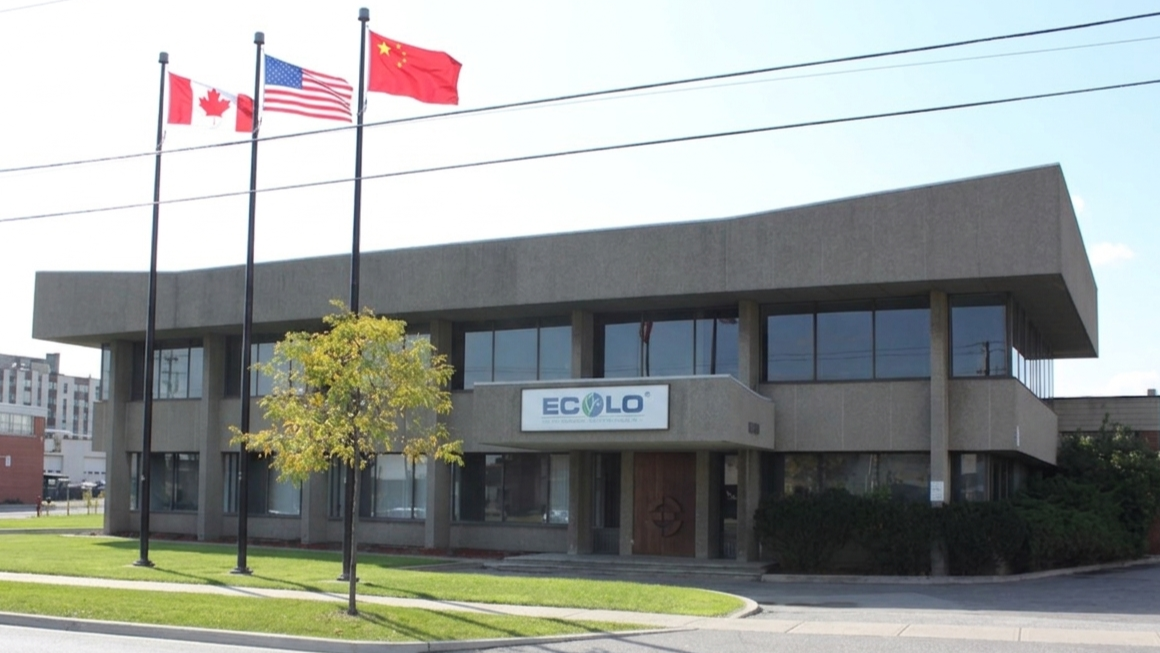
For organizations searching for odor control in Toronto, Ecolo Odor Control Technologies Inc. brings decades of formulation and application experience from its corporate headquarters in Toronto, Ontario.
From wastewater treatment plants and landfills to trash rooms, transfer stations, kitchen exhaust systems and industrial processing facilities, odor problems vary considerably. Effective treatment therefore starts by understanding where the odor originates, which compounds are involved, how the contaminated air moves and where treatment can be applied most effectively.
Ecolo develops odor-control formulations and delivery technologies designed around those variables.
A Toronto-Based Odor Control Company with Decades of Experience
Ecolo Odor Control Technologies Inc. operates its corporate headquarters in Toronto, Ontario. Company technical materials identify Ecolo's history in odor-control formulation and equipment development as dating back to 1973.
The company's Toronto operation is not simply a sales office. Ontario's Environmental Registry identifies Ecolo's North York facility as a location where liquid products are blended and packaged and confirms that the facility received an Environmental Compliance Approval for its air-emission sources.
That Toronto foundation supports applications extending well beyond the GTA.
Ecolo odor-control technologies can be configured for applications including:
- Wastewater treatment plants
- Sewage pumping and lift stations
- Landfills
- Waste transfer stations
- Recycling operations
- Composting facilities
- Garbage and compactor rooms
- Residential trash chutes
- Commercial buildings
- Industrial facilities
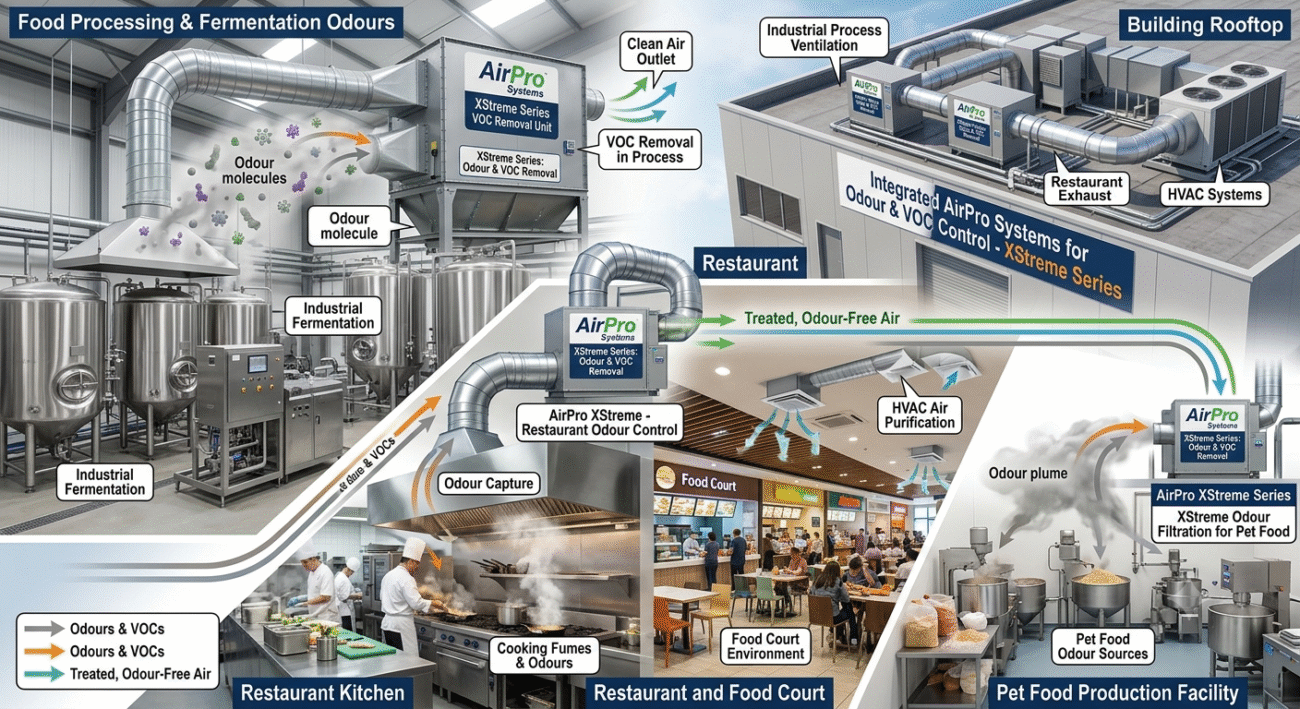
- Food-processing environments
- Kitchen exhaust systems
- HVAC and ventilation systems
- Storage areas
- Exhaust stacks
The important distinction is that these environments do not necessarily require the same chemistry or delivery technology.

Why Odor Control Matters in Toronto and Ontario
Odor management is particularly important in densely developed regions such as Toronto and the Greater Toronto Area, where wastewater, waste-management, commercial and industrial facilities may operate relatively close to residential and mixed-use neighbourhoods.
Ontario maintains guidance for industrial facilities on identifying odor sources and implementing best-management practices to prevent or minimize odor impacts.
Toronto's own municipal wastewater infrastructure demonstrates the importance of the issue.
For example, the City of Toronto reports that it has invested more than $60 million since 2008 in odor-reduction projects at the Humber Treatment Plant, including biofilters and activated-carbon systems. This is a City of Toronto project and is not presented as an Ecolo installation; rather, it demonstrates the scale at which municipalities can need to manage wastewater odors.
Odor control therefore needs to be considered as part of broader facility operations—not simply as adding fragrance to an unpleasant environment.
What Causes Industrial and Wastewater Odors?
Before selecting an industrial odor control system, the odor source should be identified.
Different applications produce very different combinations of gases, vapours and decomposing organic compounds.
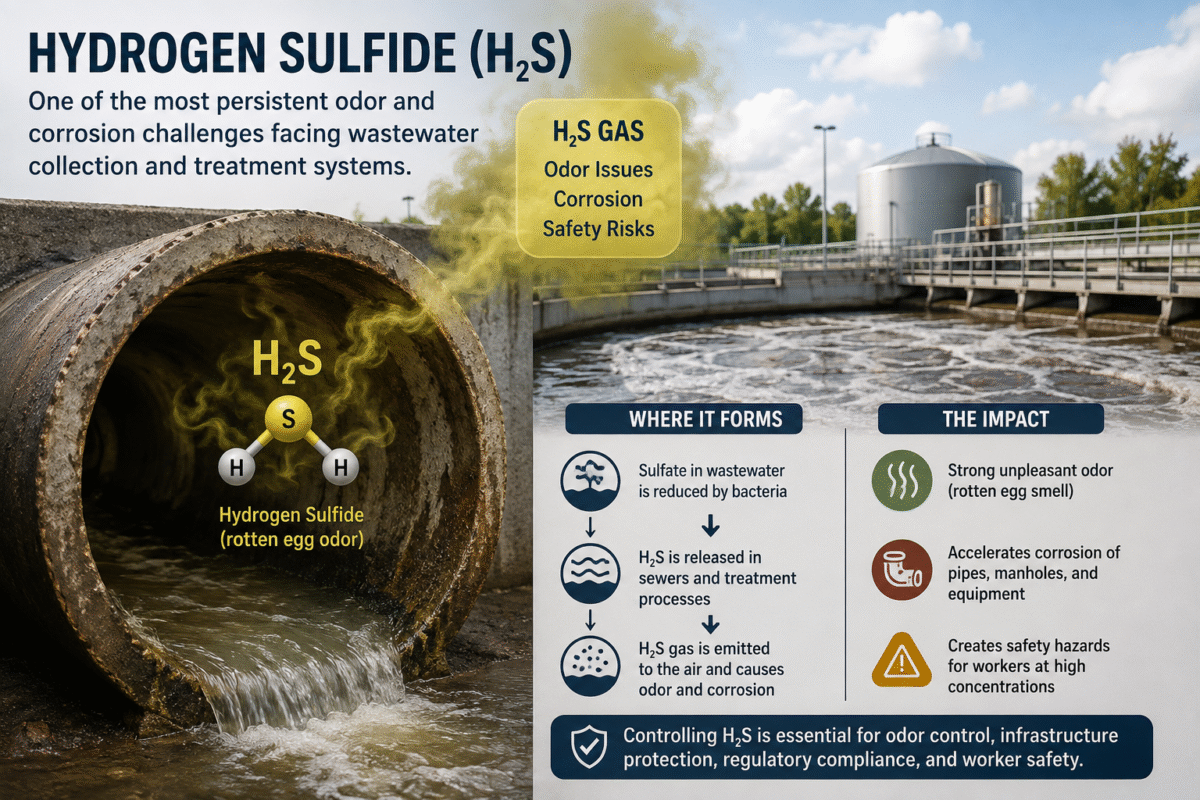
Hydrogen Sulfide and Wastewater Odor
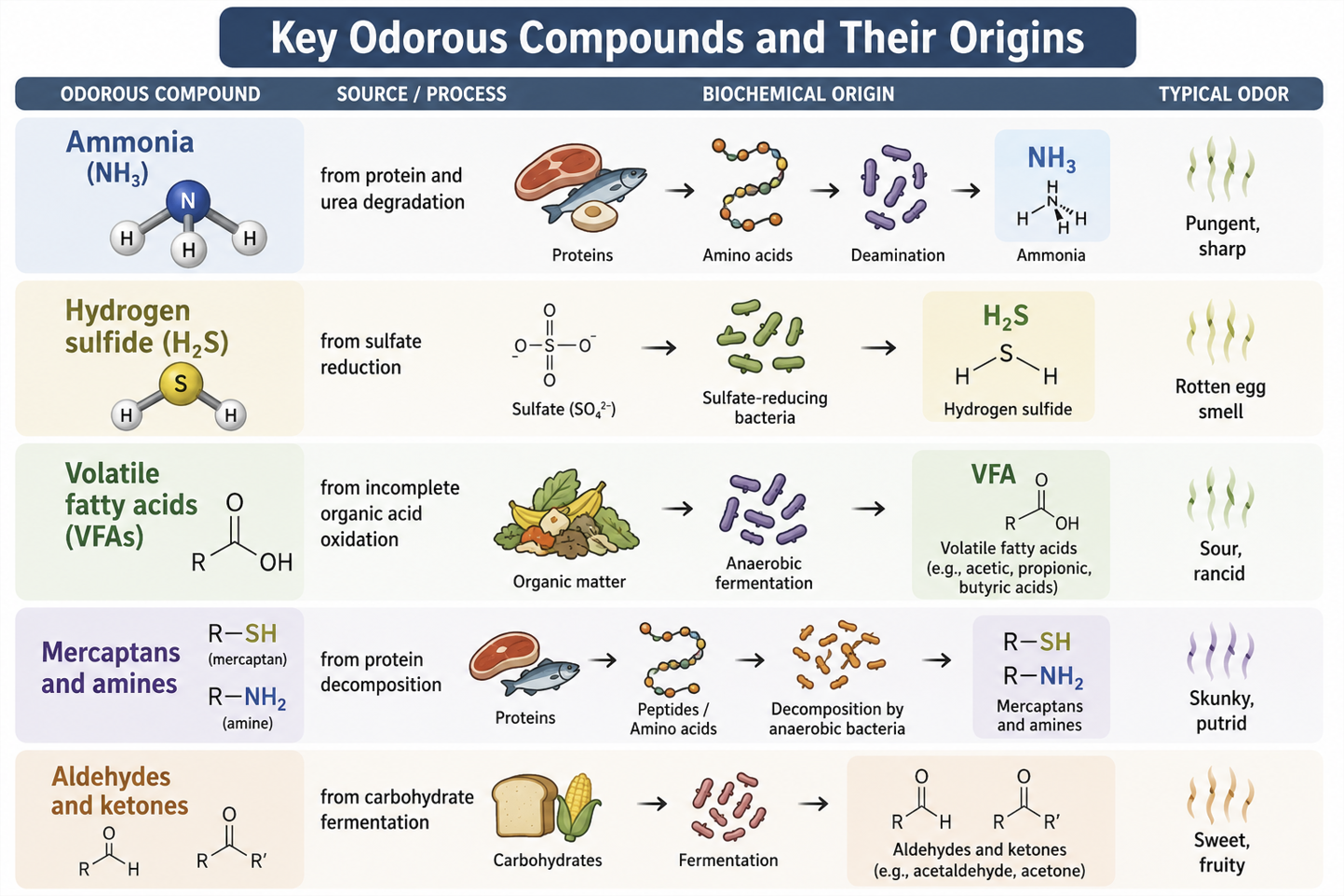
One of the best-known odor compounds associated with wastewater and sewer systems is hydrogen sulfide (H₂S).
It is commonly associated with a characteristic rotten-egg odor and can form under anaerobic conditions when microorganisms break down sulfur-containing material.
Wastewater odor may also involve:
- Mercaptans
- Reduced sulfur compounds
- Ammonia
- Amines
- Volatile organic compounds
- Organic decomposition products
- Sludge and biosolids odors
Toronto wastewater engineering documents identify hydrogen sulfide, mercaptans, other reduced sulfur compounds and volatile organics among the compounds that can evolve from biosolids and contaminate headspace air.
Is Hydrogen Sulfide Just an Odor Problem?
No.
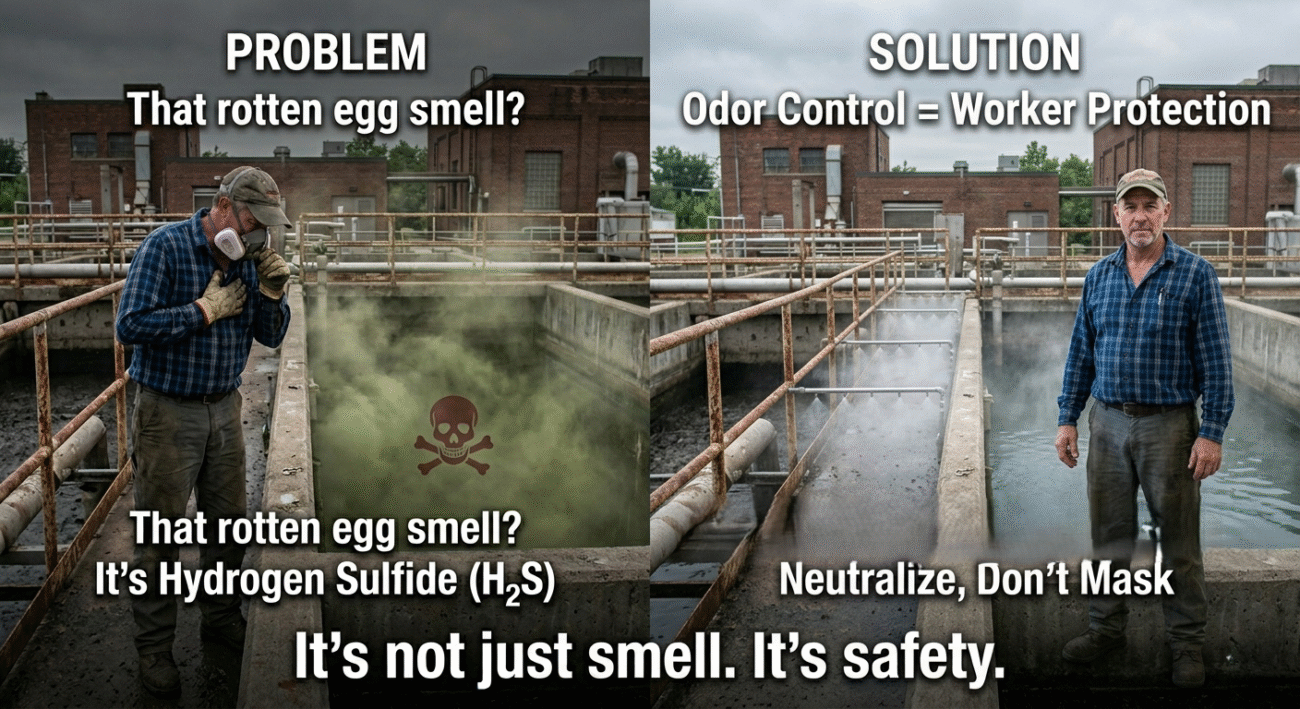
At elevated concentrations, H₂S is a significant occupational hazard. The Canadian Centre for Occupational Health and Safety classifies hydrogen sulfide as very toxic by inhalation and describes potentially severe health effects at hazardous exposure levels.
For this reason, odor-control equipment must never be treated as a replacement for required gas detection, ventilation, confined-space procedures, exposure controls or other occupational health and safety measures.
Odor neutralization and worker exposure control are related issues, but they are not the same thing.
Solid Waste and Landfill Odor
Waste facilities can generate complex odor mixtures from:
- Decomposing organic waste
- Leachate
- Sulfur compounds
- Food waste
- Wastewater
- Organic acids
- Ammonia
- VOCs
- Transfer and loading operations
Wind direction, temperature, humidity, waste composition and material-handling practices can all influence how far those odors travel.
This is why landfill odor control may require treatment around a specific working face, tipping area, transfer point, perimeter or exhaust location instead of simply treating the entire facility uniformly.
Commercial Building and Garbage Room Odor
Commercial and residential buildings present a different set of challenges.
Common sources include:
- Garbage rooms
- Trash chutes
- Compactors
- Recycling rooms
- Loading areas
- Food waste
- Parking garages
- Kitchen exhaust
- Smoking odors
- HVAC systems
- Drains
These locations often need compact, automated equipment rather than the larger misting systems that may be appropriate for landfills or industrial sites.
How Does Ecolo Approach Odor Control?
There is no single odor-control technology that is ideal for every facility.
A practical system starts with several questions:
- What is generating the odor?
- Is the odor airborne, surface-based, liquid-phase or a combination?
- Where does the contaminated air travel?
- Is the application indoors or outdoors?
- Is there an existing exhaust or ventilation system?
- How large is the treatment area?
- Is treatment required continuously or periodically?
- What operating and environmental conditions affect the site?
Once these factors are understood, the appropriate formulation and delivery method can be selected.
Air Atomization and Misting Systems
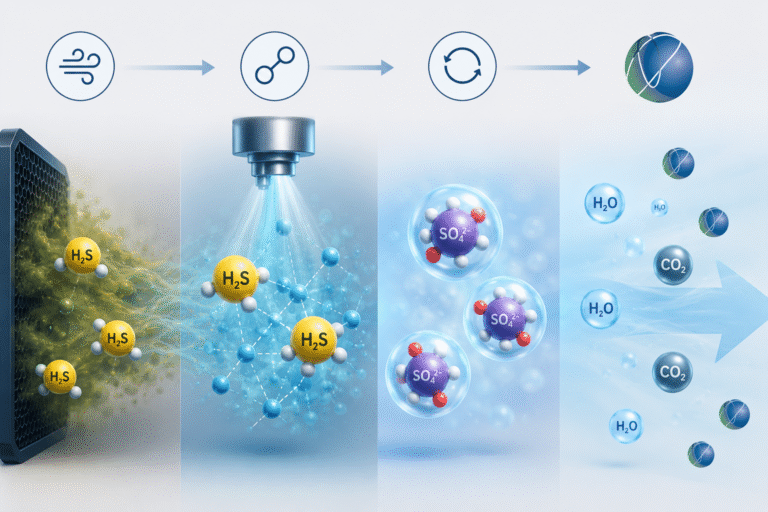
Air-assisted atomization can disperse an odor-control formulation as fine droplets into an odor plume or contaminated-air stream.
Applications can include:
- Waste transfer areas
- Wastewater facilities
- Landfills
- Industrial exhaust
- Trash rooms
- Kitchen exhaust
- Outdoor odor boundaries
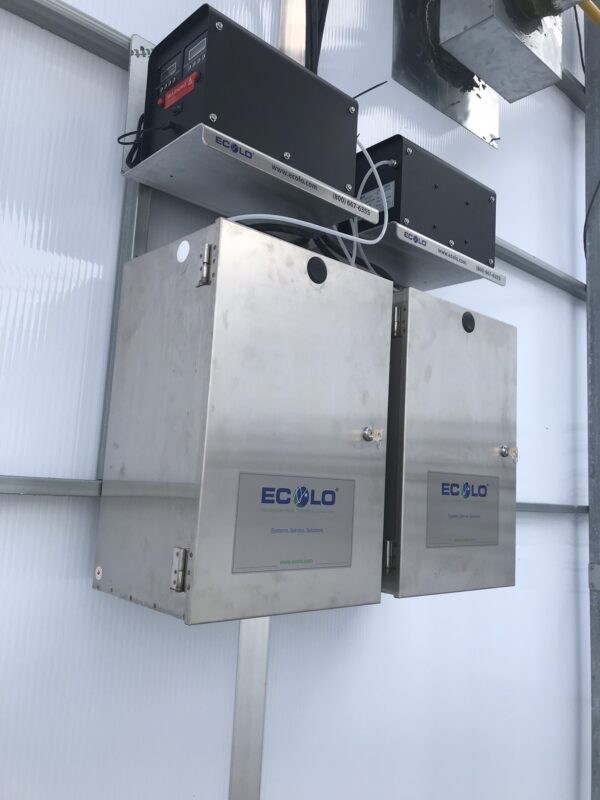
Ecolo's AirPro ACU.25, for example, can operate multiple treatment zones and can be combined with spray stations, remote mist nozzles or vapor units depending on the application. Company specifications indicate that its remote air-mist nozzles generate droplets in approximately the 10–15 micron range.
Waterless Vapor Odor Control
Some environments benefit from a waterless treatment approach.
Ecolo's XStreme™ Vapor technology is designed for use with dedicated vapor-delivery equipment. Company literature identifies applications including wastewater treatment operations, trash rooms, common areas, kitchen exhaust and HVAC environments.
Vapor systems may be particularly useful where continuous airborne distribution is required or where adding water to the environment is undesirable.
AirSolution™ Odor Control
Ecolo's AirSolution™ formulations are designed for airborne odor-control applications and can be delivered through suitable misting and atomization systems.
Depending on the formulation and application, this approach can be considered for locations such as:
- Waste facilities
- Wastewater operations
- Landfills
- Transfer stations
- Trash areas
- Industrial processes
- Exhaust streams
Internal link opportunity: Link AirSolution odor-control products to the AirSolution product category.
BioStreme™ for Source and Surface Applications
Not every odor problem begins in the air.
Organic contamination, wastewater, sludge, drains, surfaces and accumulated waste can continue generating odor even when the surrounding air has been treated.
For these situations, source-level or topical treatment may form part of a broader odor-management strategy.
Ecolo's BioStreme™ product family includes formulations associated with applications such as wastewater and organic waste treatment.
Internal link opportunity: Link BioStreme biological odor-control products to the BioStreme product category.
Wastewater Treatment Plant Odor Control
Wastewater is one of the most technically demanding odor-control applications because odor can originate at multiple points in the process.
Potential treatment locations include:
Headworks and Screening Areas
Incoming wastewater may release concentrated odors as it is agitated during screening and preliminary treatment.
Lift Stations and Pumping Stations
Low-flow conditions, long retention times and anaerobic conditions can contribute to the formation of sulfur-based odors.
Sludge Thickening and Dewatering
Processing and exposing sludge can release substantial odor loads into enclosed rooms and exhaust air.
Biosolids Handling
Storage, conveying and truck-loading operations may release hydrogen sulfide, mercaptans, VOCs and other compounds.
Lagoons and Open Basins
Large exposed surface areas can make treatment more difficult because weather and wind affect odor movement.

How Do Wastewater Treatment Plants Control Hydrogen Sulfide Odors?
There is no universal method.
Depending on the facility, wastewater odor-control strategies can include:
- Preventing sulfide formation in the liquid phase
- Capturing contaminated air
- Ventilation
- Activated carbon
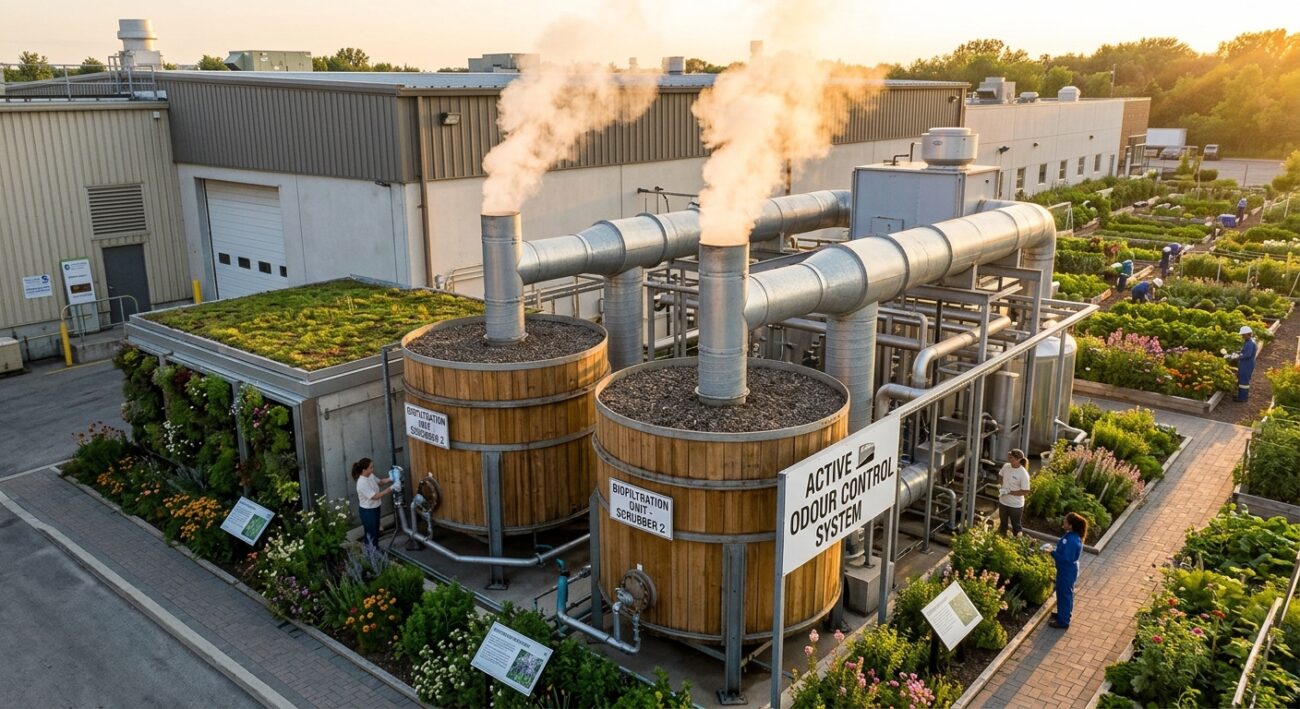
- Biofiltration
- Chemical scrubbers
- Source treatment
- Airborne neutralization
- Mist or vapor treatment
- Operational changes
The appropriate strategy depends on the concentration, airflow, process conditions, treatment objective and regulatory requirements.
A neutralizing mist or vapor system can therefore be one component of an overall wastewater odor-management program rather than automatically replacing existing process controls.
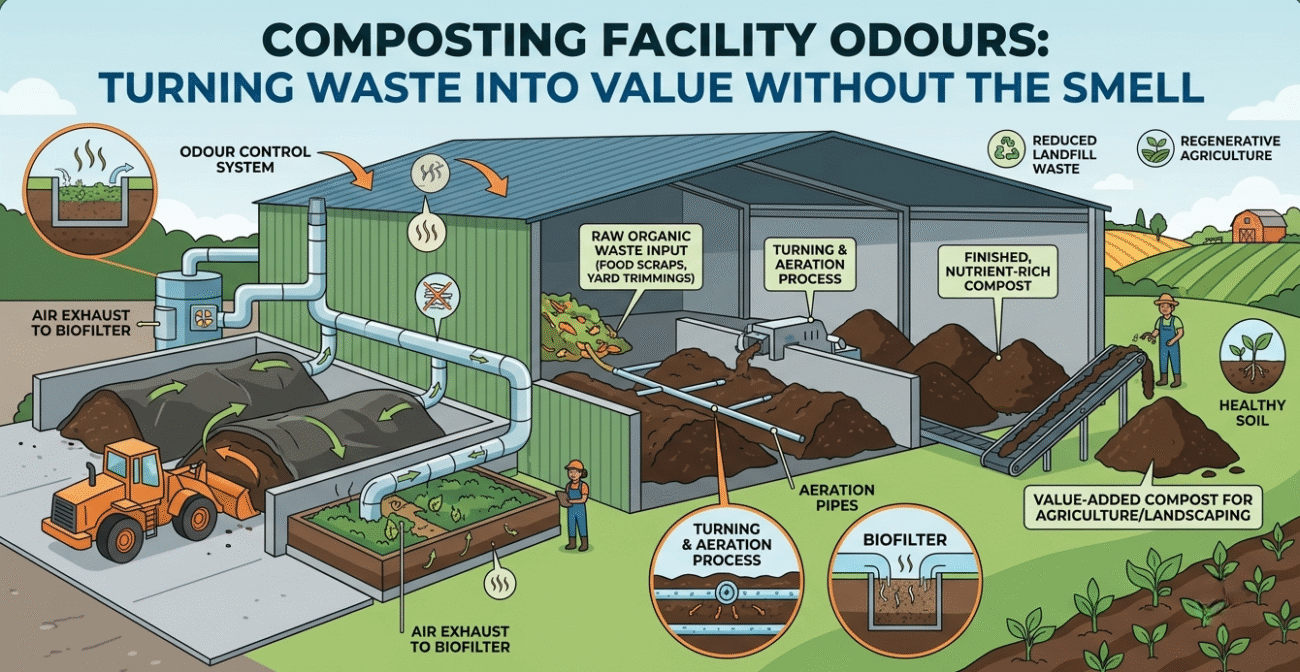
Odor Control for Landfills, Transfer Stations and Composting Facilities
Waste-management sites present another challenging combination of changing odor sources and environmental conditions.
A landfill may need odor treatment around:
- Working faces
- Leachate areas
- Waste unloading zones
- Transfer buildings
- Perimeters
- Exhaust points
A composting operation may instead be dealing with odor from active decomposition, turning operations, receiving areas, curing material and exhaust air.
The delivery technology should consequently be designed around where the odor travels, rather than simply where the equipment can most easily be installed.
Commercial Odor Control in Toronto
Industrial facilities are not the only locations where professional odor control is required.
Across Toronto and the GTA, property managers, facility managers and service contractors can encounter persistent odors in:
- Condominium garbage rooms
- Apartment trash chutes
- Commercial kitchens
- Hotels
- Shopping centres
- Office buildings
- Parking structures
- Food-service facilities
- Loading docks
- Compactor rooms
In these smaller applications, automatically controlled spray or vapor equipment can allow treatment to occur at scheduled intervals without requiring staff to manually apply deodorizing products throughout the day.
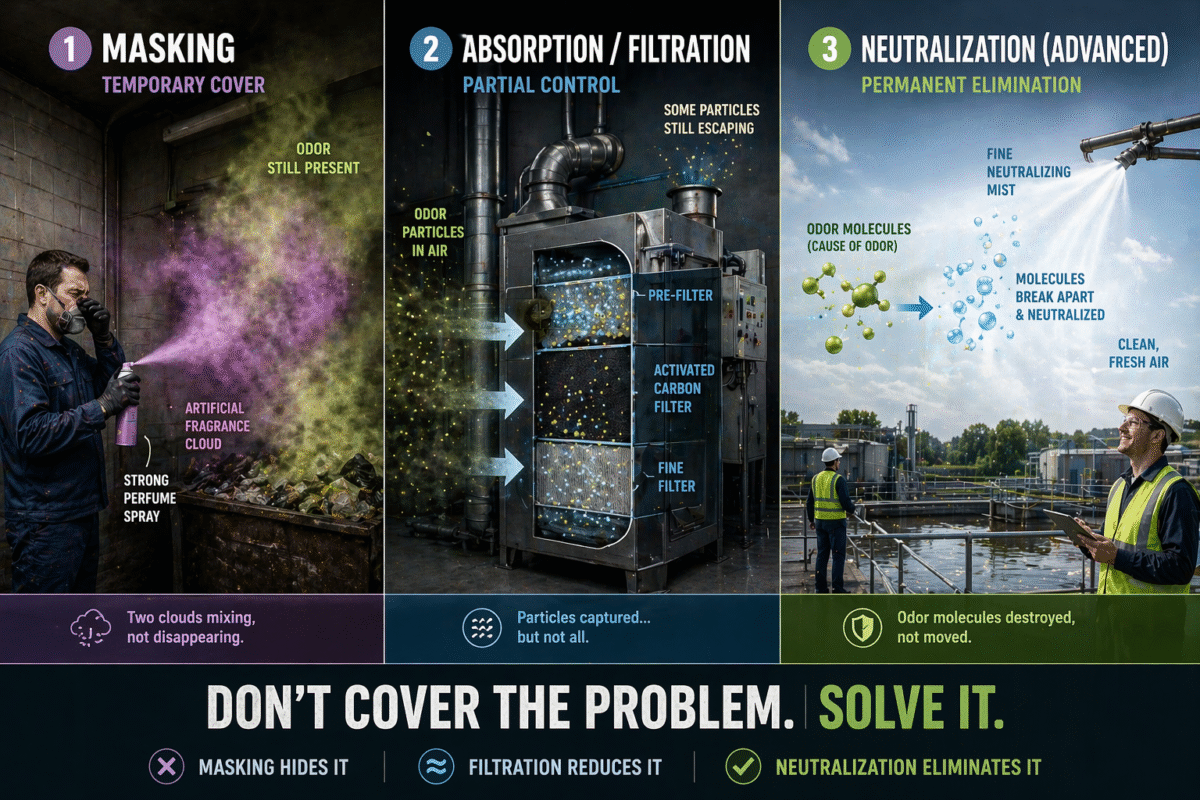
The objective should remain odor management at the appropriate source or air pathway, not simply overwhelming the unwanted odor with fragrance.

Why Having Ecolo's Headquarters in Toronto Matters
For Canadian organizations searching for an odor control company in Toronto, local technical and manufacturing infrastructure can provide practical advantages.
Ecolo's corporate headquarters is located in Toronto, and Ontario government records identify its North York facility as a blending and packaging operation.
That means Ecolo's Toronto presence is directly connected to its odor-control operations rather than functioning solely as a representative sales address.
For customers, this can support:
- Technical product consultation
- Application review
- Product selection
- Equipment selection
- Canadian supply
- Product documentation
- Commercial and industrial project support
- Coordination for projects outside Ontario and Canada
At the same time, every odor problem should be evaluated individually. A system used successfully in a garbage room, for example, should not automatically be assumed to be appropriate for a wastewater lift station or landfill.
What Makes a Good Industrial Odor-Control Program?
Equipment alone does not determine success.
A strong odor-management program should consider the entire pathway from odor generation to receptor.
1. Identify the Source
Determine exactly where the odor is being generated.
2. Understand the Airflow
Determine where the odor travels and whether exhaust fans, prevailing winds or HVAC systems are moving it.
3. Identify the Likely Compounds
Wastewater H₂S requires different considerations from food waste, smoke, VOCs or rendering odors.
4. Select the Treatment Point
Treatment may be more effective:
- At the source
- Inside a duct
- At an exhaust point
- Around a perimeter
- In the contaminated room
- In the liquid or waste material itself
5. Select the Correct Delivery Technology
Options may include misting, vaporization, topical application or combination treatment.
6. Adjust the Program Based on Results
Weather, seasonal temperatures, production levels and changing waste loads can affect odor generation.
Effective odor control is therefore often an operating program, not simply a piece of equipment installed once and forgotten.
Benefits of a Properly Designed Odor-Control System
When correctly selected and operated, an odor-management program can help facilities:
- Reduce nuisance odors
- Improve conditions around odor-generating operations
- Reduce odor migration toward neighbouring properties
- Improve visitor and occupant experience
- Address difficult treatment points
- Automate chemical delivery
- Target specific odor sources
- Integrate treatment with existing ventilation or exhaust infrastructure
The actual performance of any odor-control system depends on site conditions, odor concentration, treatment design, equipment configuration and operation.
For that reason, performance claims should be based on the specific application rather than generalized to every facility.
Limitations: What Odor Control Cannot Replace
Professional odor-control technology has an important role, but it is not a substitute for proper facility management.
Odor treatment should not replace:
- Required ventilation
- H₂S or hazardous-gas monitoring
- Occupational exposure controls
- Proper waste handling
- Preventive maintenance
- Cleaning and sanitation
- Process corrections
- Environmental compliance obligations
- Engineering controls required by regulation
Ontario's guidance encourages industrial facilities to systematically identify odor sources and implement measures to prevent or minimize emissions.
The best solution may therefore combine operational improvement, source control and airborne treatment.
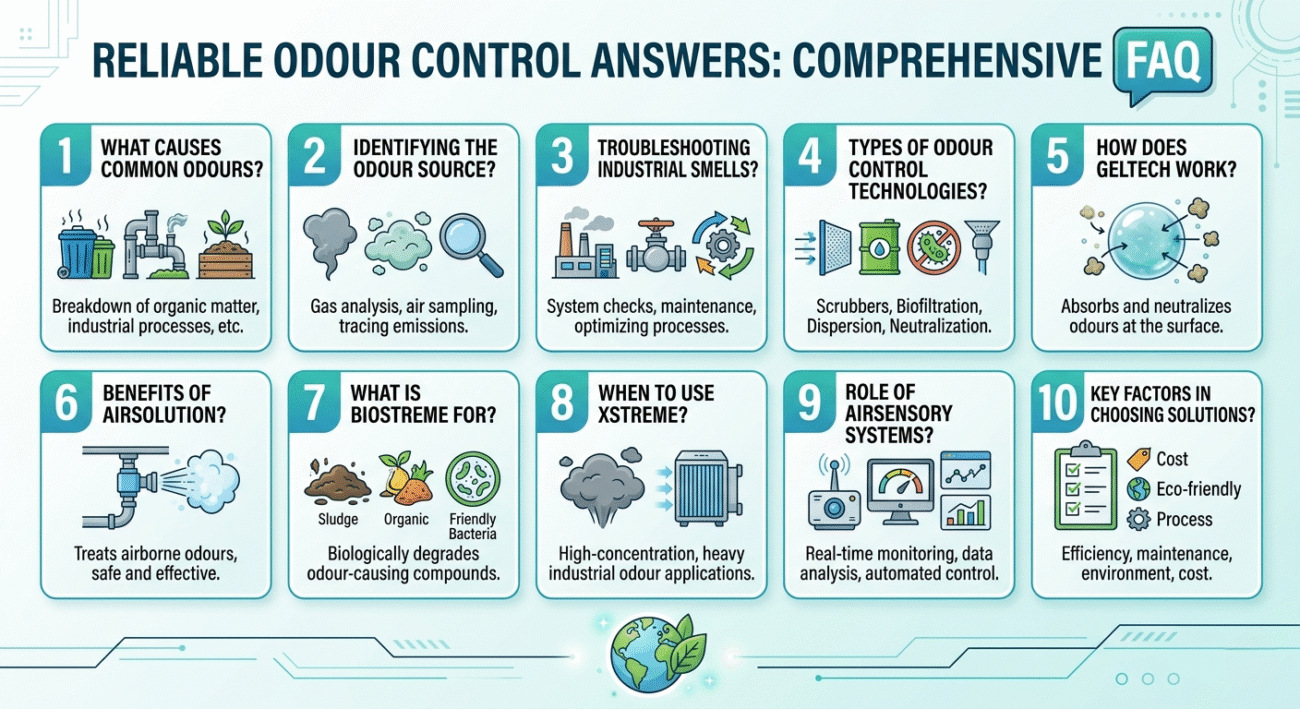
Frequently Asked Questions About Odor Control in Toronto
What is the best odor-control system for an industrial facility?
There is no single best system for every industrial application. The appropriate technology depends on the odor source, compounds involved, airflow, concentration, facility layout, operating environment and desired treatment point.
A site or application assessment should normally come before final equipment selection.
Can odor-control systems be used in wastewater treatment plants?
Yes. Odor-control technologies can be applied at lift stations, screening rooms, sludge-processing areas, biosolids operations, exhaust systems and other odor-generating points.
The solution should be selected according to the specific compounds and operating conditions.
How do wastewater treatment plants control hydrogen sulfide odors?
Facilities may use liquid-phase treatment, ventilation, carbon adsorption, biological filtration, chemical scrubbing, containment, airborne neutralization or combinations of these methods.
Because H₂S can also present a serious health hazard, odor treatment must not replace appropriate safety controls and gas monitoring.
Does Ecolo provide odor control in Toronto?
Ecolo Odor Control Technologies Inc. maintains its corporate headquarters in Toronto, Ontario, with operations connected to the development, blending and packaging of odor-control products.
What industries use Ecolo odor-control technology?
Applications can include wastewater, solid waste, landfills, industrial processing, trash rooms, commercial buildings, kitchen exhaust, HVAC systems and other environments where persistent odors require targeted treatment.
Is odor neutralization the same as masking an odor?
Not necessarily. Masking relies primarily on introducing a stronger fragrance. Professional odor-control strategies may instead target odor-generating material, treat contaminated air or use neutralizing formulations and engineered delivery systems.
The appropriate mechanism depends on the chemistry and application.
Can an odor-control system be installed in an HVAC or exhaust system?
In some applications, yes. Ductwork, HVAC systems and exhaust streams can provide useful treatment points because they allow contaminated air to be treated as it moves through a controlled pathway.
System design should account for airflow, equipment location, material compatibility and treatment requirements.
Toronto Expertise with Applications Beyond Toronto
Toronto is home to Ecolo's corporate headquarters, but odor-control challenges are not limited by geography.
Wastewater treatment plants, landfills, industrial facilities and commercial buildings around Ontario, across Canada and internationally face many of the same fundamental questions:
What is causing the odor? Where is it moving? And what is the most efficient place to treat it?
Since 1973, Ecolo has developed odor-control formulations and delivery technologies intended to address these challenges across a range of commercial, municipal and industrial applications.
For organizations searching for odor control in Toronto, the starting point should not simply be choosing a chemical or machine.
It should be understanding the odor.
Need Help with an Odor Problem?
If your facility is experiencing persistent odor from wastewater, solid waste, industrial processing, garbage areas, exhaust systems or another source, Ecolo can review the application and help determine an appropriate treatment approach.
Request an odor-control assessment, technical consultation, product recommendation, sample or quotation from Ecolo's Toronto team.
When contacting Ecolo, provide as much information as possible about:
- The source of the odor
- Facility type
- Approximate treatment area
- Indoor or outdoor conditions
- Ventilation or exhaust systems
- Operating hours
- Known odor compounds
- Photos or drawings of the site
The more accurately the odor source and operating conditions are understood, the more accurately a treatment strategy can be developed.