




How to Measure Odor in Indiana: Tools, Metrics and Reporting

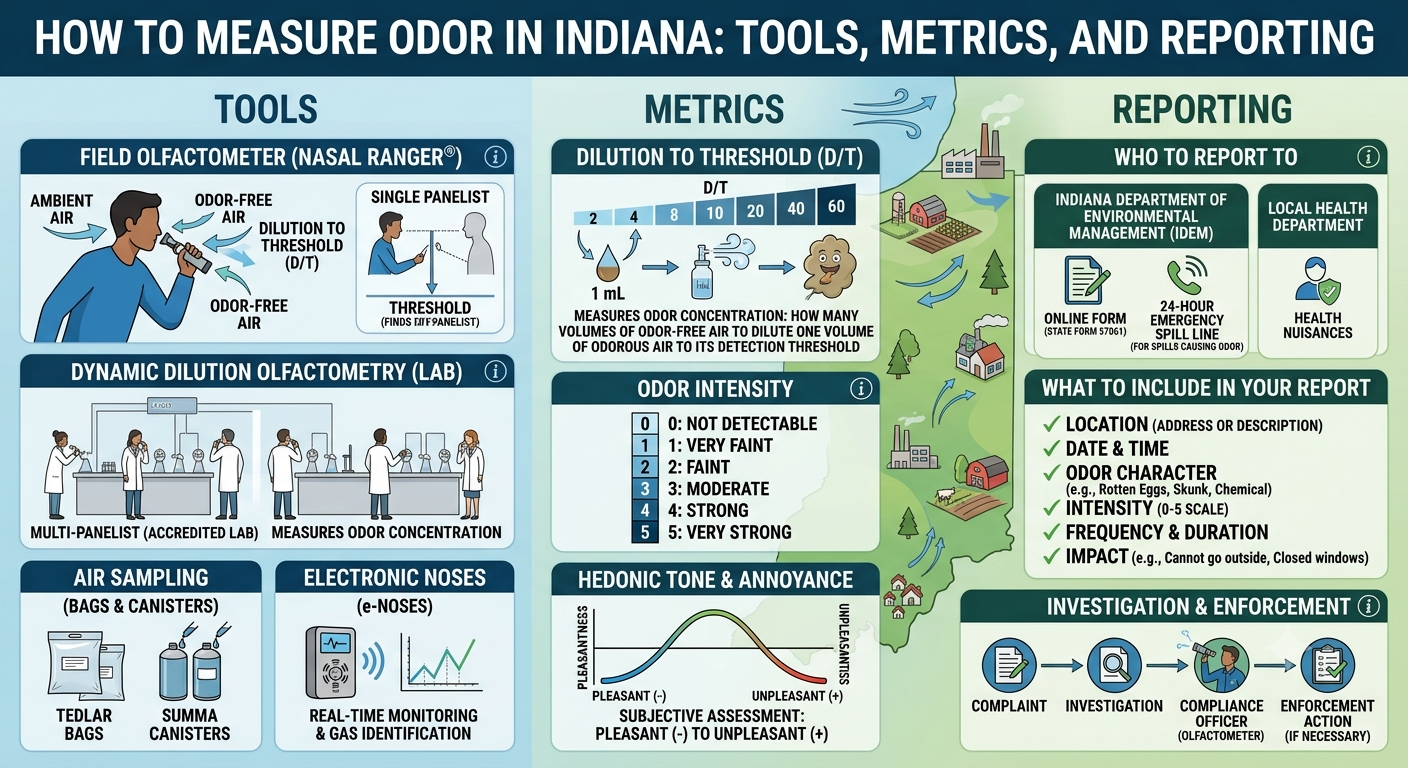
Odor complaints can create significant environmental, operational and community-relations challenges for facilities throughout Indiana.
Wastewater treatment plants, landfills, food-processing facilities, rendering operations, manufacturing plants and agricultural facilities may all generate odors that affect employees, neighboring properties and surrounding communities.
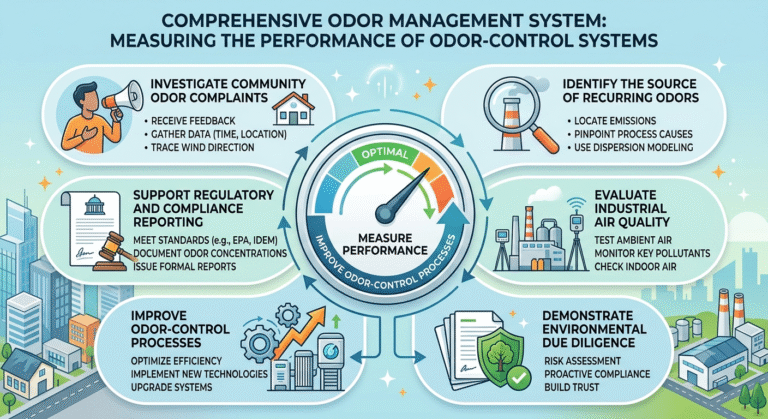
In cities and industrial regions such as Indianapolis, Fort Wayne, Evansville, South Bend, Gary, Bloomington, Lafayette and Terre Haute, accurate odor measurement can help facilities:
- Investigate community odor complaints
- Identify the source of recurring odors
- Evaluate industrial air quality
- Demonstrate environmental due diligence
- Improve odor-control processes
- Support regulatory and compliance reporting
- Measure the performance of odor-control systems
Modern facilities should not rely exclusively on subjective smell observations. Scientific odor assessments combine sensory testing, instrumental analysis, field observations and atmospheric dispersion modeling.
1. Why Odor Measurement Matters in Indiana
Odor measurement helps Indiana businesses understand when, where and why odor emissions occur.
Industrial and municipal facilities may need odor assessments when they are:
- Receiving complaints from nearby residents
- Expanding operations
- Modifying production processes
- Evaluating wastewater or waste-handling systems
- Installing odor-control equipment
- Preparing environmental documentation
- Investigating air-quality concerns
- Measuring the effectiveness of corrective actions
Indiana facilities may also need to consider requirements and guidance from the Indiana Department of Environmental Management, local authorities and the U.S. Environmental Protection Agency, depending on the facility, emissions and applicable permits.
Odor measurement is not simply about determining whether something smells unpleasant. A comprehensive assessment examines:
- Chemical concentration
- Odor concentration
- Perceived intensity
- Odor character
- Frequency and duration
- Weather conditions
- Atmospheric dispersion
- Distance to nearby receptors
These factors help facilities make informed decisions about odor mitigation and community impact.
2. Understanding the Basics of Odor Measurement
2.1 What Is an Odor?
An odor is produced when volatile compounds interact with human olfactory receptors.
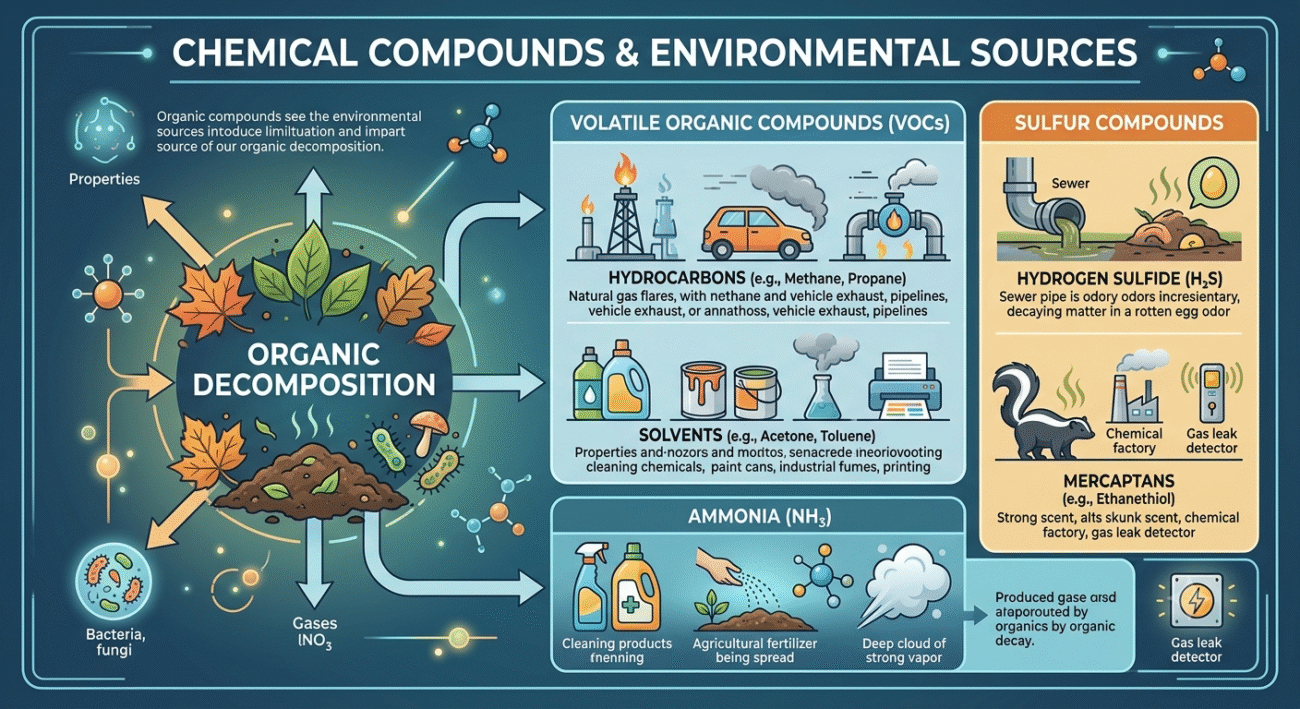
Common odor-producing compounds include:
- Hydrogen sulfide, or H₂S
- Ammonia, or NH₃
- Mercaptans
- Volatile fatty acids
- Amines
- Sulfur-containing compounds
- Volatile organic compounds, or VOCs
These compounds differ in detection threshold, intensity, persistence and odor character.
For example, hydrogen sulfide may produce a rotten-egg smell, while ammonia may create a sharp or irritating odor. Other industrial emissions may smell musty, earthy, chemical, smoky, oily or organic.
Because odor combines chemistry with human perception, odor measurement requires both instrumental and sensory methods.
2.2 Why Measuring Odor Is Challenging
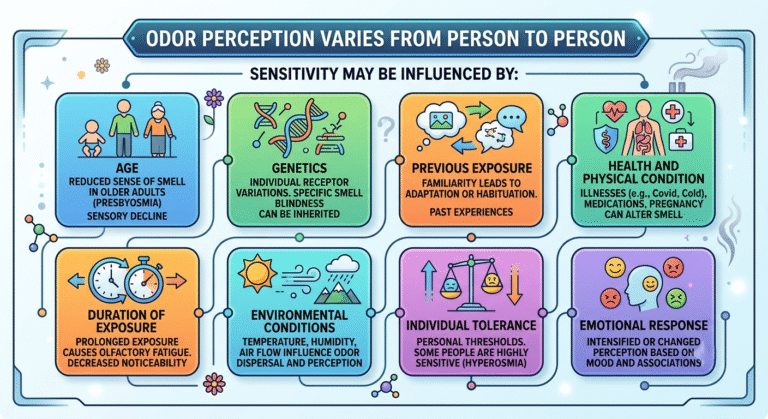
Odor perception varies from person to person.
Sensitivity may be influenced by:
- Age
- Genetics
- Previous exposure
- Health and physical condition
- Duration of exposure
- Environmental conditions
- Individual tolerance
- Emotional response
A smell that is noticeable to one person may not be detectable to another. For this reason, standardized odor-testing methods use trained sensory panels, controlled dilution equipment and repeatable testing procedures.
A comprehensive Indiana odor assessment may include:
- Human sensory testing
- Chemical identification
- Field odor observations
- Meteorological data
- Dispersion modeling
- Operational records
- Community complaint data
Together, these methods turn subjective odor observations into measurable and reportable information.
3. The Core Metric: Odor Units
3.1 What Is an Odor Unit?
Odor concentration is commonly expressed in odor units per cubic meter, written as OU/m³.
An odor unit represents the number of times an odorous air sample must be diluted with odor-free air before it reaches the detection threshold of a qualified sensory panel.
In simplified terms:
- 1 OU/m³: approximately the threshold at which an odor becomes detectable
- 10 OU/m³: a clearly noticeable odor
- 1,000 OU/m³: a highly concentrated and potentially significant odor source
Actual perception and nuisance impact depend on more than concentration alone. Frequency, duration, offensiveness, weather and proximity to homes or businesses must also be considered.
3.2 Odor Concentration Versus Odor Intensity
Odor concentration and odor intensity are related, but they are not identical.
Odor concentration describes the dilution level required before an odor becomes undetectable.
Odor intensity describes how strong the odor appears to a person.
A complete odor assessment may evaluate four sensory characteristics:
- Concentration: How much detectable odor is present
- Intensity: How strong the odor appears
- Character: What the odor smells like
- Hedonic tone: How pleasant or unpleasant the odor is perceived to be
These parameters help Indiana facilities evaluate the actual impact of odor emissions rather than relying on chemical readings alone.
4. Core Methods for Measuring Odor
4.1 Dynamic Olfactometry
Dynamic olfactometry is a widely recognized laboratory method for measuring odor concentration.
The general process includes:
- Air sampling: Odorous air is collected from an emission source using an inert sampling bag.
- Sample transportation: The sample is protected from contamination and delivered to the laboratory.
- Controlled dilution: An olfactometer dilutes the sample with odor-free air.
- Sensory evaluation: Qualified panelists identify when the odor becomes detectable.
- Calculation: The dilution threshold is converted into an odor concentration, usually expressed in OU/m³.
Dynamic olfactometry may be used for:
- Wastewater exhaust systems
- Landfill gas emissions
- Composting facilities
- Food-processing exhaust
- Rendering plants
- Agricultural buildings
- Manufacturing operations
- Industrial ventilation systems
Benefits
- Standardized testing procedure
- Quantifiable results
- Useful for before-and-after comparisons
- Suitable for environmental reporting
- Recognized internationally
Limitations
- Requires qualified laboratory personnel
- Samples must be collected and handled carefully
- Does not identify individual chemical compounds
- Represents conditions at the time of sampling
4.2 Chemical and Instrumental Analysis
Chemical analysis can identify the specific compounds contributing to an odor problem.
Common analytical tools include:
- Gas chromatography
- Mass spectrometry
- Flame ionization detectors
- Photoionization detectors
- Hydrogen sulfide monitors
- Ammonia sensors
- Sulfur analyzers
- VOC monitoring instruments
Gas chromatography and mass spectrometry may be used together to separate and identify compounds within an air sample.
Instrumental testing is particularly useful when an Indiana facility needs to determine whether an odor is associated with:
- Hydrogen sulfide
- Ammonia
- Mercaptans
- Hydrocarbons
- Solvents
- VOCs
- Sulfur compounds
- Organic decomposition
Chemical measurements should generally be interpreted alongside sensory information because a low chemical concentration may still produce a noticeable odor when the compound has a very low detection threshold.
4.3 Field Olfactometry
Field olfactometry measures odor directly at or near the affected location.
Portable field olfactometers allow a trained operator to mix ambient air with filtered air at different dilution ratios. The operator identifies the point at which the odor becomes detectable.
Field olfactometry can support:
- Community complaint investigations
- Property-line assessments
- Facility inspections
- Odor plume tracking
- Source identification
- Verification of dispersion models
- Before-and-after odor-control testing
This method may be useful around wastewater plants, industrial parks, agricultural facilities and landfills near Indianapolis, Fort Wayne, Evansville, South Bend, Lafayette and other Indiana communities.
Advantages
- Immediate on-site observations
- Portable equipment
- Useful for tracking odor movement
- Can evaluate multiple locations during one survey
Limitations
- Results depend on operator training
- Weather can change rapidly
- Wind direction affects observations
- A single observation may not represent long-term conditions
4.4 Electronic Noses
Electronic noses, commonly called e-noses, use arrays of gas sensors and analytical software to identify odor patterns.
These systems may provide:
- Continuous odor monitoring
- Real-time alerts
- Trend analysis
- Automated data recording
- Process-condition comparisons
- Early warning of odor events
Electronic noses can be useful for Indiana facilities with recurring or intermittent odor problems because they can collect information over longer periods than individual air samples.
However, an e-nose must be properly calibrated for the facility and odor sources being monitored.
5. Odor Sampling and Data Integrity
5.1 Odor-Sampling Equipment
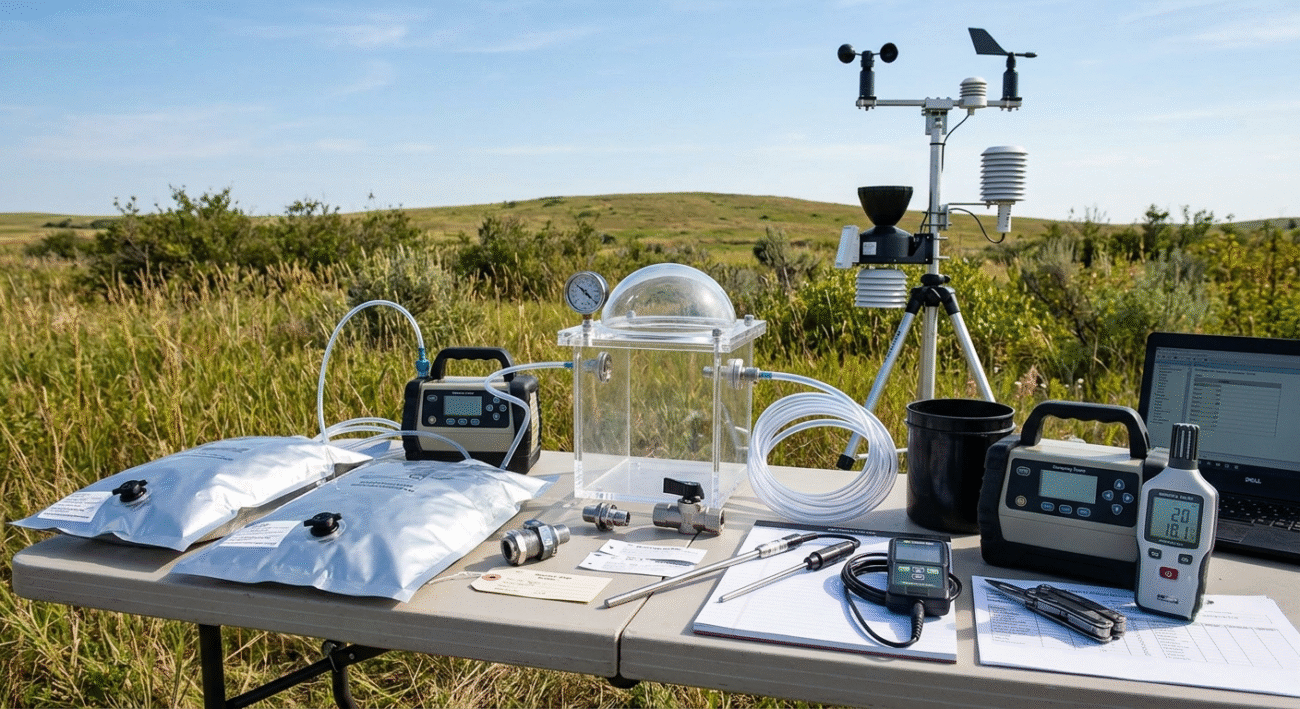
Common equipment includes:
- Inert sample bags
- Vacuum chambers
- Sampling pumps
- Non-reactive tubing
- Sample ports
- Temperature sensors
- Humidity meters
- Weather-monitoring instruments
Sampling materials should not absorb, react with or release compounds that could alter the sample.
5.2 Sampling Best Practices
Reliable odor testing requires a documented sampling procedure.
Best practices include:
- Using clean and odor-free equipment
- Avoiding cross-contamination
- Sampling during representative operating conditions
- Recording production activity during sampling
- Documenting wind direction and wind speed
- Recording temperature and humidity
- Properly labeling every sample
- Maintaining chain-of-custody documentation
- Transporting samples according to laboratory instructions
- Analyzing samples within the appropriate holding period
For intermittent odor problems, sampling should be coordinated with the process or activity most likely to generate emissions.
Examples include sludge handling, waste deliveries, tank cleaning, production changes, manure handling, wastewater agitation or exhaust-system operation.
6. Odor Dispersion Modeling
6.1 Why Model Odor?
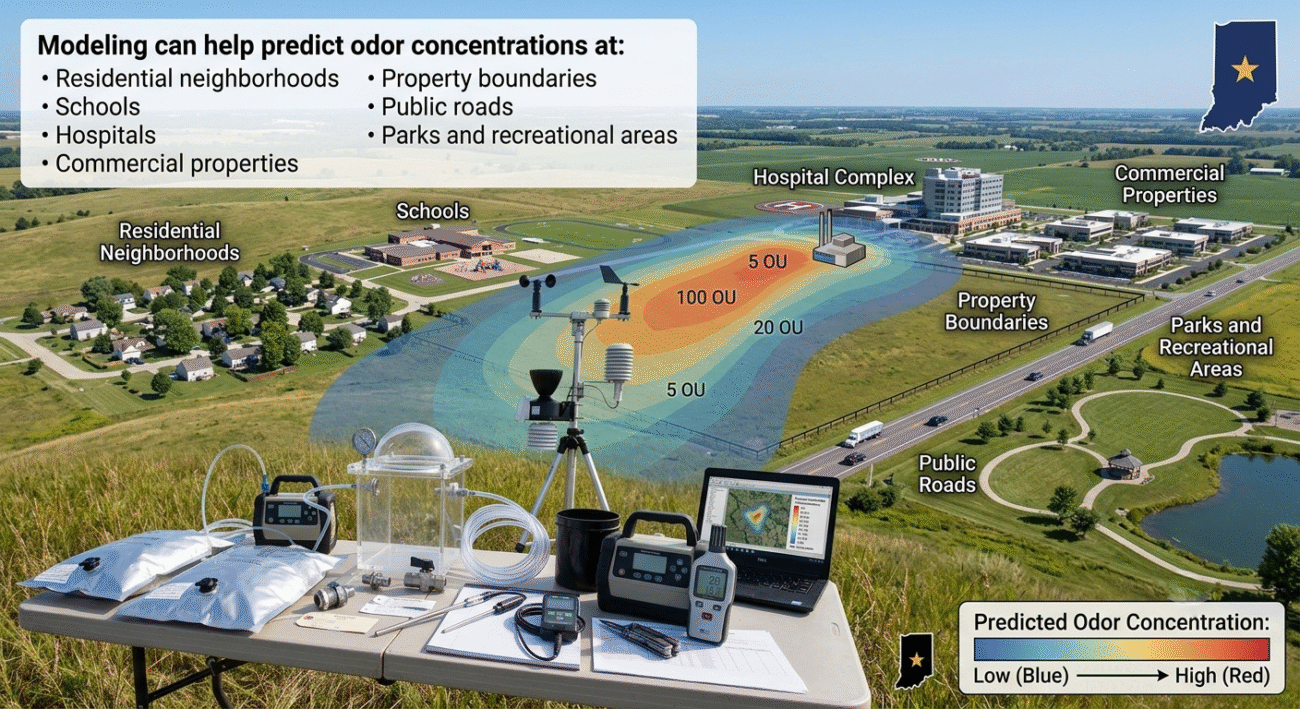
Air sampling shows the odor concentration at a specific source and time. Dispersion modeling estimates how the odor may travel through the surrounding environment.
Modeling can help predict odor concentrations at:
- Residential neighborhoods
- Schools
- Hospitals
- Commercial properties
- Property boundaries
- Public roads
- Parks and recreational areas
This can be important for industrial or municipal facilities near populated areas such as Indianapolis, Carmel, Fishers, Fort Wayne, South Bend, Evansville and Bloomington.
6.2 Common Dispersion Models
AERMOD
AERMOD is commonly used in the United States to assess emissions from industrial sources. It considers source characteristics, terrain and meteorological conditions.
CALPUFF
CALPUFF may be used for more complex terrain, variable weather conditions or longer-range transport assessments.
Real-Time Odor Platforms
Commercial odor-monitoring platforms may combine sensor information, weather data and dispersion calculations to estimate odor movement in real time.
A dispersion model may use:
- Odor-emission rates
- Stack height
- Exhaust velocity
- Source dimensions
- Wind speed
- Wind direction
- Atmospheric stability
- Terrain data
- Building dimensions
- Receptor locations
Model accuracy depends heavily on the quality of the source and meteorological data.
7. Key Odor Metrics
Metric
Description
Unit or Scale
Purpose
Odor concentration
Amount of detectable odor in an air sample
OU/m³
Standardized odor measurement
Odor intensity
Perceived strength of an odor
Sensory scale
Evaluates human perception
Odor frequency
How often an odor occurs
Percentage of time
Measures recurring impact
Odor duration
How long each event lasts
Minutes or hours
Evaluates exposure
Odor character
Description of the smell
Descriptive category
Supports source identification
Hedonic tone
Pleasantness or unpleasantness
Sensory scale
Evaluates nuisance potential
Impact distance
Distance an odor travels
Feet, miles, meters or kilometers
Supports planning and modeling
Chemical concentration
Amount of a specific compound
ppm, ppb or mg/m³
Identifies individual pollutants
A credible odor assessment should consider several of these metrics rather than relying on one number.
8. Odor Reporting and Environmental Compliance in Indiana
Indiana facilities should evaluate which federal, state, permit-specific and local requirements apply to their operations.
Relevant authorities may include:
- Indiana Department of Environmental Management
- U.S. Environmental Protection Agency
- County and municipal authorities
- Local health departments
- Facility-specific air-permitting agencies
Applicable obligations depend on the source, facility type, chemical emissions, permit conditions and location.
8.1 Information Included in an Odor Assessment Report
A professional odor report may include:
- Facility and process description
- Purpose of the assessment
- Sampling locations
- Sampling dates and times
- Operational conditions
- Weather conditions
- Odor-testing methodology
- Laboratory results
- Chemical-analysis results
- Field-observation records
- Maps of sampling locations
- Complaint-history analysis
- Dispersion-modeling results
- Identified odor sources
- Recommended corrective actions
- Follow-up monitoring plan
The report should clearly distinguish measured data, observations, assumptions and modeled results.
9. Odor Measurement in Different Indiana Industries
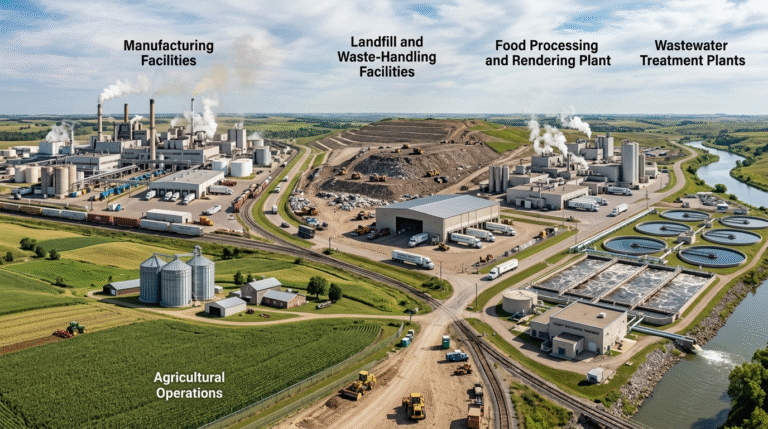
9.1 Wastewater Treatment Plants
Wastewater odor may originate from:
- Headworks
- Lift stations
- Screens
- Grit chambers
- Equalization tanks
- Sludge storage
- Dewatering equipment
- Biosolids handling
Hydrogen sulfide, ammonia and other sulfur-containing compounds are common concerns.
Search terms relevant to this application include:
- wastewater odor control Indiana
- lift station odor control Indianapolis
- sewage odor monitoring Fort Wayne
- wastewater treatment odor Evansville
- hydrogen sulfide control Indiana
9.2 Landfills and Waste-Handling Facilities
Potential odor sources include:
- Working faces
- Leachate systems
- Gas-collection systems
- Transfer stations
- Organic waste
- Compactors
- Waste-storage areas
Measurement can help distinguish landfill gas, decomposing organic material, leachate odor and off-site sources.
Relevant keywords include:
- landfill odor control Indiana
- waste facility odor monitoring Indiana
- transfer station odor Indianapolis
- garbage odor control Fort Wayne
- solid waste odor assessment Indiana
9.3 Food Processing and Rendering
Odors may be generated by:
- Raw-material storage
- Cooking
- Frying
- Rendering
- Wash water
- Wastewater
- Grease
- Exhaust systems
- Organic by-products
Relevant keywords include:
- food processing odor control Indiana
- rendering plant odor monitoring Indiana
- industrial exhaust odor Indianapolis
- food plant odor testing Fort Wayne
- commercial odor control Evansville
9.4 Agricultural Operations
Indiana agricultural facilities may experience odors from:
- Manure storage
- Livestock buildings
- Poultry houses
- Lagoons
- Composting
- Land application
- Feed storage
- Anaerobic decomposition
Relevant keywords include:
- farm odor control Indiana
- livestock odor management Indiana
- poultry farm odor control Indiana
- manure lagoon odor Indiana
- agricultural odor assessment Indiana
9.5 Manufacturing Facilities
Manufacturing odors may be associated with:
- Solvents
- Coatings
- Chemical reactions
- Heated materials
- Wastewater
- Exhaust stacks
- Storage tanks
- Cleaning operations
- Production by-products
Relevant keywords include:
- manufacturing odor control Indiana
- industrial odor testing Indianapolis
- factory odor monitoring Fort Wayne
- VOC odor assessment Indiana
- industrial air quality testing Indiana
10. Measuring the Effectiveness of Odor-Control Systems
Odor measurement should be performed before and after implementing a mitigation system.
A basic performance evaluation may include:
- Establishing baseline odor conditions
- Identifying major emission points
- Recording operating and weather conditions
- Installing or applying the selected odor-control method
- Repeating testing under comparable conditions
- Comparing odor concentration and intensity
- Documenting changes in community complaints
- Adjusting the system as necessary
Performance indicators may include:
- Reduction in OU/m³
- Lower hydrogen sulfide readings
- Lower ammonia readings
- Reduced VOC concentrations
- Lower odor intensity
- Shorter odor-event duration
- Reduced impact distance
- Fewer community complaints
Any claimed reduction percentage should be supported by project-specific testing conducted under comparable conditions.
11. Emerging Trends in Odor Analytics
11.1 Real-Time Monitoring
Real-time sensors allow facilities to observe odor-related conditions continuously instead of relying only on periodic samples.
These systems can monitor:
- Hydrogen sulfide
- Ammonia
- VOCs
- Temperature
- Humidity
- Wind speed
- Wind direction
- Process conditions
Alerts can be created when readings exceed a defined operating threshold.
11.2 Artificial Intelligence and Predictive Monitoring
Artificial intelligence can compare odor or gas-sensor readings with:
- Production schedules
- Weather conditions
- Equipment status
- Waste deliveries
- Tank levels
- Ventilation rates
- Historical complaint records
The system may then identify patterns and forecast periods when odor risks are more likely to increase.
11.3 Geographic Information Systems
Geographic information systems can map:
- Complaint locations
- Odor observations
- Facility sources
- Wind direction
- Sensitive receptors
- Predicted odor plumes
This provides a clearer picture of how odor events affect surrounding Indiana communities.

12. Building an Odor-Management Program
Step 1: Conduct a Baseline Assessment
Measure existing conditions at major emission points, property boundaries and nearby receptors.
Step 2: Identify and Prioritize Sources
Determine which processes generate the strongest, most frequent or most objectionable odors.
Step 3: Select a Control Strategy
Possible approaches include:
- Source containment
- Improved ventilation
- Process optimization
- Chemical neutralization
- Biological treatment
- Activated carbon
- Scrubbers
- Vapor-phase treatment
- Misting or atomization
- Improved housekeeping
- Waste-handling changes
Step 4: Monitor Performance
Repeat field observations, gas measurements or olfactometry after implementing corrective actions.
Step 5: Document and Report
Maintain records of:
- Monitoring results
- Weather conditions
- Operational changes
- Maintenance activities
- Complaints
- Corrective actions
- Follow-up results
Step 6: Improve Continuously
Use the collected data to optimize treatment, reduce chemical consumption, improve system placement and prevent future odor events.
13. Best Practices for Odor Reporting
Indiana facilities should use reporting procedures that are consistent, transparent and traceable.
Recommended practices include:
- Using recognized testing methods
- Clearly identifying sampling locations
- Maintaining chain-of-custody records
- Recording operating conditions
- Recording meteorological conditions
- Including maps, charts and trend lines
- Comparing similar operating periods
- Separating observations from conclusions
- Explaining limitations and uncertainties
- Retaining calibration and maintenance records
- Documenting corrective actions
- Scheduling follow-up assessments
Well-organized reporting demonstrates environmental responsibility and helps facilities respond more effectively to regulators, customers and nearby communities.
14. Conclusion: Measuring and Managing Odor in Indiana
Odor may be invisible, but it can be measured, documented and managed.
Dynamic olfactometry, chemical analysis, field olfactometry, electronic noses and dispersion modeling provide Indiana facilities with practical methods for understanding odor emissions.
Whether the concern involves a wastewater treatment plant in Indianapolis, a manufacturing facility in Fort Wayne, a food-processing operation in Evansville, an agricultural facility near Lafayette or a waste-handling site in Northwest Indiana, the measurement process should begin with reliable data.
By establishing baseline conditions, identifying emission sources, implementing appropriate controls and verifying the results, facilities can:
- Improve regulatory readiness
- Reduce community complaints
- Protect workplace and community air quality
- Optimize odor-control systems
- Demonstrate environmental due diligence
- Build stronger relationships with neighboring communities
The principle is straightforward:
When odor can be measured accurately, it can be managed more effectively.